


Ministry of Justice refuses to lift ‘foreign agent’ status from Yabloko Deputy Chairman Vladimir Dorokhov over a ‘birthday greeting card’ from Nikolai Rybakov
Press Release, 23.07.2026

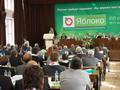
Photo: Vladimir Dorokhov at a Yabloko event in 2023 / Photo by the Yabloko Press Service
Vladimir Dorokhov, Deputy Chairman of Yabloko and a member of the party’s Federal Bureau, who was designated a “foreign agent” in 2024, has been refused by the Ministry of Justice in his bid to have this status lifted. The reason given for the refusal was that Dorokhov had continued to engage in political activity, namely, receiving a birthday greeting from the party Chairman on the Yabloko website, regularly laying flowers at memorials to victims of political repression, and joining Yabloko’s demands for Telegram’s blocking to be lifted. Vladimir Dorokhov has pointed to the “absurdity of the Ministry’s arguments,” remarking that the official letter from the state agency reads more like a note “from a madhouse”.
It should be noted, by way of context, that Vladimir Dorokhov has been a member of Yabloko since 2006 and headed the party’s Tula regional branch for many years. In September 2024, he was placed on the Ministry of Justice’s register of “foreign agents” over an alleged receipt of “foreign funding”. His placement on the register had been preceded by a provocation: two transfers of 2,000 roubles each had been made to Dorokhov’s bank card from an unknown sender in Armenia. The politician had immediately contacted his bank and returned the money to the sender.
However, when the case against the Ministry of Justice went to court in the autumn of 2024, it emerged that Dorokhov had in fact received “foreign funds” on his card on three different occasions, totalling less than a thousand roubles. Each transfer had come from a Sberbank client: one during a taxi ride, when the driver, a native of Tajikistan, had returned his change by card transfer; one at a market, where a fruit seller, a native of Uzbekistan, had likewise returned change by transfer; and one from a courier, a native of Vietnam, who had returned Dorokhov’s change the same way.
In May 2026, Vladimir Dorokhov applied to the Ministry of Justice, pointing to the absence of foreign funding — the principal ground for having the status lifted under the “Foreign Agents” law (No. 255-FZ). The Ministry’s refusal arrived in the summer; the agency explained its position by citing identified “facts of political activity”.
According to the Ministry’s inspection report, officials from its NGO department had spent 20 days examining Yabloko’s public communications. The inspection found that Vladimir Dorokhov was engaged in political activity by virtue of being Deputy Chairman of a political party.
The Ministry’s commission then devotes two pages of the inspection report to quoting the “foreign agents” legislation, setting out what is meant by “foreign influence,” what by “support”, and what by “political activity”. It should be noted that the law’s wording is left maximally vague and can be interpreted whatever is convenient.
“It has been established that, during the period under review, the person’s activity was conducted in breach of the law, and that the person’s activity meets the criteria of a foreign agent,” the Ministry of Justice concludes.
Vladimir Dorokhov, for his part, stresses that his story — from the “Armenian provocation” to the Ministry’s 2026 response — resembles not a legal procedure but a literary exercise in Kafkaesque absurdity:
“First they explained to me that I was engaged in political activity because I had once received a few roubles from citizens of CIS countries. When that argument fell apart — there were no such payments — the agency was not in the least embarrassed, and produced a new piece of ‘evidence’: the party Chairman had wished me a happy birthday. What’s saddest here isn’t even the absurdity of the arguments. A state body that is obliged to uphold the law is systematically substituting it with arbitrary explanations, and each new response contradicts the last. Letters from the Ministry that is supposed to be one of the most authoritative bodies in the country read like letters from a madhouse.”
Dorokhov notes that “history has a way of putting everything in its place,” and that the time when the Russian state will once again begin to live by the law “will inevitably come”: “And when it does, the authors of all these responses won’t need to try to recall exactly what they wrote — the documents bearing their signatures have already been carefully filed away.”
Read more details here.
Posted: July 23rd, 2026 under Elections, Freedom of Speech, Governance, Human Rights, Без рубрики.