



St. Petersburg Yabloko files a lawsuit against a governor’s decree restricting freedom of assembly
Press Release, 19.11.2026

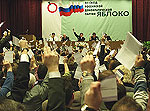
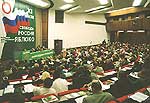
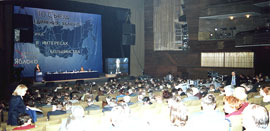
Photo: A rally in St. Petersburg (archive photo) / Photo by St. Petersburg Yabloko
The St. Petersburg branch of Yabloko has filed an administrative claim with the St. Petersburg City Court challenging a decree by Governor Alexander Beglov that imposes bans and restrictions on public events. The claim was filed by Alexander Kobrinsky, Deputy Chairman of St. Petersburg Yabloko, who will represent the regional branch in court.
It should be noted that the contested act:
- introduces bans not provided for by the Constitution of the Russian Federation or the Federal Law “On Rallies”, prohibiting public events unless otherwise provided for by the St. Petersburg and Leningrad Region Departments of the Ministry of Internal Affairs and the National Guard (Rosgvardia);
- limits the number of participants in events to 500, and reduces the number of designated sites (so-called “Hyde Parks”, i.e. places specially designated for rallies) for holding protests from eight to two;
- prohibits more than one event per day at the same venue;
- sets special deadlines for submitting notifications and introduces requirements for the technical equipment of the sites.
St. Petersburg Yabloko noted that none of these restrictions is contained in the law “On Rallies”, which, on the contrary, explicitly allows mass events with large numbers of participants.
Dmitry Anisimov, Chairman of St. Petersburg Yabloko, stressed that the conditions and bans established by the governor’s decree make it so difficult to hold public events that they effectively nullify Article 31 of the Constitution on freedom of assembly in St. Petersburg:
“The executive branch does not have, and cannot have, such powers. If the executive branch is worried that citizens will take to the streets to protest against its policies, then, in our view, it should be tackling the causes, not the consequences. To do this, it needs to engage in dialogue with society, listen to different groups of St. Petersburg residents and take their opinions and interests into account, rather than building a façade of bans that supposedly demonstrate universal consent and well-being. As history shows, such practices are simply dangerous for the city and the country.”
The plaintiffs are asking the court to declare the decree inoperative from the moment of its publication.
Posted: November 24th, 2026 under Freedom of Assembly, Freedom of Speech, Governance, Human Rights, Judiciary, Yabloko's Regional Branches.