



Trial begins in Alexander Shishlov’s second case — on “abuse of freedom of mass media”
Press Release, 30.04.2026

Photo: Alexander Shishlov / Photo by the Yaboko Press Service
On Thursday, 30 April, a hearing was held at the magistrates’ court of the Petrograd District of St. Petersburg (precinct no. 153) in the administrative case against Alexander Shishlov, Coordinator of the Federal Political Committee of the Yabloko party. The prosecution was prompted by a Telegram repost from three years ago — an interview with Grigory Yavlinsky from the Zhivoy Gvozd project. Shishlov is charged under Article 13.15 Part 9 of the Code of Administrative Offences of the Russian Federation (“abuse of freedom of mass media”).
It should be noted that just a week earlier, on 24 April, Shishlov, who was at that point still the leader of the Yabloko faction in the St. Petersburg Legislative Assembly, had already been found guilty of displaying extremist symbols, again in connection with the same interview. That ruling stripped the politician of the right to stand in elections for a period of one year, thus banning him from the parliamentary elections and elections to the St. Petersburg Legislative Assemble, both are due in September 2026. Following this, Alexander Shishlov resigned his deputy’s mandate in the Legislative Assembly; his successor is Dmitry Anisimov, Deputy Chairman of the St. Petersburg branch of Yabloko.
Thursday’s court hearing opened with a defence motion to transfer the case to a different jurisdiction. The lawyers argued that the place of the offence was the place where it had been detected. The inspection report of 29 January 2026 had been drawn up at the Centre E (the Centre for Combatting Extremism under the Interior Ministry) at 8 Ruzovskaya Street, which falls under judicial precinct no. 5. The judge retired to deliberate but dismissed the motion.
The main event of the day was the examination of the evidence of the prosecution’s key “specialist” witness, Alexei Bogachev, whose report forms the effective basis of the entire case. In court, Bogachev appeared confused: his answers were disjointed, he contradicted himself, and he was visibly nervous. He ultimately conceded, in effect, that the primary objective of his assessment had been to demonstrate the absence from the video of the required disclaimers regarding the extremist status of the organisations and individuals mentioned.
However, when the video was played in the court, it emerged that the required labels were visible on screen for virtually the entire duration of the interview.
Bogachev was unable to offer any coherent explanation for why he had “failed to notice” them in the course of his examination. Nor could he explain which documents had guided his decision that references to terrorist and extremist designations were required.

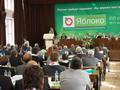
Photo: Court hearing, 30 April / Photo by St. Petersburg Yabloko
A devastating blow to the prosecution’s case was delivered by the defence expert Svetlana Drugoveiko-Dolzhanskaya, Senior Research Fellow at the Vinogradov Institute of the Russian Language of the Russian Academy of Sciences, member of the Academy’s Spelling Commission and of the Philological Council of the Total Dictation project.
In her assessment, Bogachev’s report was based primarily on personal opinion and failed to meet the requirements of a comprehensive expert examination. Such an examination of a video ought to involve specialists from multiple disciplines — linguists, political scientists, and psychologists. Bogachev himself, meanwhile, holds confirmed qualifications only in the field of psychology.
Svetlana Drugoveiko-Dolzhanskaya also demonstrated conclusively that the methodologies cited in the report had not in fact been applied at all, even Bogachev himself failed to explain clearly which research methodologies he had actually used.
Following the examination of witnesses and the viewing of the recording, the defence lodged a motion to have Bogachev’s report declared inadmissible as evidence.
As the hearing had run significantly over time, lasting more than two and a half hours, the judge decided to adjourn the case to Friday, 8 May, at 10:00.
Posted: May 6th, 2026 under Elections, Freedom of Speech, Governance, Human Rights, Judiciary, Regional and Local Elections, Regional and Local Elections 2026, State Duma Elections, State Duma Elections 2026, YABLOKO's faction in St.Petersburg Legislative Assembly, Yabloko's Regional Branches.