


Nikolai Rybakov: “They can take away our freedom, but no one will manage to take away our faith, our thoughts and our convictions”
Press Release, 6.12.2025

Photo: Nikolai Rybakov / Photo by the Yabloko Press Service
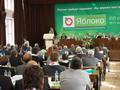
Yabloko Party Chairman Nikolai Rybakov spoke at the Federal Council of Yabloko, where he reported on the state of affairs in the party and the main directions of work for 2025.
“At every minute of our meeting, hostilities continue, every minute people are dying, and repression continues. Peace has not come, freedom has not come, fear continues. That is why in this hall you see the words PEACE and FREEDOM,” Rybakov began his speech.
He spoke about his morning conversation with Zhanna, the wife of Lev Shlosberg who was arrested yesterday, to whom he conveyed words of support from the entire party, and she in return conveyed words of solidarity with the party friends and colleagues gathered today in Moscow.
Rybakov noted that important things in our history help us endure this time. One such example is the demonstration by seven Soviet dissidents on Red Square on 25 August 1968 against the occupation of Czechoslovakia by Warsaw Pact troops. The first president of the Czech Republic, Václav Havel, highly praised the demonstrators’ action:
“The citizens who protested in August 1968 on Red Square against the occupation of Czechoslovakia by Warsaw Pact troops showed human solidarity and the greatest personal courage. I highly value their action also because they knew well what they were doing and what could be expected from Soviet power. For the citizens of Czechoslovakia, these people became the conscience of the Soviet Union, whose leadership unhesitatingly carried out a vile military attack on a sovereign state and ally. After the ‘Demonstration of the Seven’, the Prague newspaper Literární Listy wrote: ‘Seven people on Red Square – that is at least seven reasons why we can never hate the Russians’.”
The party leader spoke about the consequences of Yabloko members’ struggle for peace and freedom:
11 party members were under administrative arrest, 58 people were fined, 36 of them for discreditation (many were fined repeatedly), 29 people were subjected to detention; searches were conducted of 34 people, as well as in five regional offices; 13 party members and two regional organisations have had their social network accounts blocked.
Rybakov named criminal cases against Yabloko members as the heaviest ordeal. He said that criminal cases have been opened against 13 Yabloko members. Currently in detention are journalist and member of Khakassia Yabloko Mikhail Afanasyev, leader of the Kamchatka branch of the party Vladimir Yefimov, Deputy Chairman of the party Maxim Kruglov, journalist and Chairman of the Ryazan branch of the party Konstantin Smirnov, member of St.Petersburg Yabloko and lecturer Vasily Neustroyev. Lev Shlosberg was also sent to a remand prison yesterday.
Nikolai Rybakov also added that lawyer from the Kaliningrad branch Vladimir Sorokin is restricted in his freedom of action, whilst leader of Yakutsk Yabloko Anatoly Nagovitsyn and of Vologda Yabloko Nikolai Yegorov were fined large sums.
The party head stopped separately on the case of Deputy Chair of the Maritime Yabloko Marina Zheleznyakova, whom the court fined 2 million roubles in November 2025:
“This is a fine for an absolutely honest publication on social networks about World War II. So that everyone understands how one has to defend one’s case in the courts, I can say that at Marina Zheleznyakova’s trial, prosecution witnesses and experts claimed that there were no secret protocols to the Molotov–Ribbentrop Pact.”
Criminal cases have also been opened against party members who are currently not in Russia: Alexander Goncharenko from Altai Yabloko and Vasily Tsypenda from the Yaroslavl branch of the party.
The “absolutely despicable and unjust status of ‘foreign agents'” was given to ten party members: three Yabloko Deputy Chairmen Lev Shlosberg, Boris Vishnevsky and Vladimir Dorokhov; member of the Federal Political Committee Svetlana Gannushkina, Nobel Peace Prize laureate and journalist Dmitry Muratov, member of the Federal Bureau of the party Andrei Morev, head of the Veliky Novgorod branch Ksenia Cherepanova, member of the Bureau of Pskov Yabloko Nikolai Kuzmin, Sergei Troshin from St.Petersburg and Nikolai Kavkazsky from Moscow.
Rybakov emphasised that despite the pressure and repression, the party will continue its work so that this time ends, so that there will never be political prisoners in Russia.
Nikolai Rybakov then summed up the party’s work for 2025, speaking about the continued work of the Yabloko Party University, Federal Party School, and School for Candidate Deputies.
Support for prisoners also continues: attending pre-trial hearings, supporting lawyers, charity auctions, subscriptions to publications for prisoners, parcels, regular actions of writing letters to political prisoners, financial aid for relatives of arrested party members, and collection of donations to pay fines. Thanks to supporters’ donations, it was possible to pay Yabloko members’ fines totalling 6 million roubles.
Rybakov also told that over 10 million roubles were raised during eight auctions held by Yabloko, and 6,500 letters were sent to political prisoners at letter-writing actions in Moscow and St Petersburg alone during 2025.
Work on peacemaking, environmental, educational and humanitarian projects continues. Rybakov gave examples: media publications, the YouTube project “Say YES to Peace” (readings of anti-war works of classical literature); extinguishing forest fires, helping shelters for homeless animals, lectures, seminars, film screenings, theatrical performances, and literary series.
Rybakov drew particular attention to the serious work of Yabloko deputies in regional (St.Petersburg, Karelia, and the Pskov Region) and city (Pskov, Veliky Novgorod, Tomsk, and Yekaterinburg) parliaments.
Rybakov stopped separately on Yabloko’s work on de-Stalinisation – this includes collecting signatures for the dismantling of the Stalin bas-relief in the Moscow Metro, defending monuments to victims of political repression, a campaign against renaming Volgograd as Stalingrad, and also the all-Russian online marathon of reading names of victims of political repression “People, Don’t Kill Each Other”.
“Our other friends and colleagues said that a huge mistake of the 1990s and early 2000s in terms of work for the future was that state decisions were not adopted that would have condemned Stalinism and made the return of Stalinist practices impossible. They are returning. Denunciations are returning, court proceedings of this format are returning, when you know that you are speaking the absolute truth, the law is on your side, but you can do nothing,” Rybakov stated.
Summing up the directions of Yabloko’s work in 2025, Nikolai Rybakov emphasised that the party uses a wide variety of forms to talk about its most important position – that nothing is more important than human life.
Speaking about the 2025 election campaign, Rybakov stated that on average Yabloko candidates received 14.4%. Given that the elections took place in very difficult regions, 270 candidates were nominated in 27 regions. And after collecting signatures, 164 candidates were registered in 19 regions. They conducted 39 campaigns.
The party leader drew attention to the fact that according to opinion polls, around 60% of Russian citizens support Yabloko’s position, even if they are not party supporters, and that “Yabloko’s work would be impossible if there were not millions of people in the country who support us and are ready to vote for Yabloko”.
“We continue, despite everything, to work, and carry our flag, not lowering it. And we will continue to do so. Because for very many people, the very presence of Yabloko in Russian politics, in real Russian life, allows them to hope and believe in the future,” Rybakov stated.
The Yabloko leader also stated that the party now faces a great historical challenge, “because our role now is not simply to give people hope, but to try to turn our country onto the path of development that we consider correct. A path of development in which people stand at the centre of all politics”:
“The killing of people will never become something ordinary for us. We will never reconcile ourselves to the fact that people are being killed. We will never become accustomed to hatred, malice and aggression. And in Russia, dozens of millions of people think the same way as we do. Yes, we understand the state of affairs perfectly well. And we know that they can take away our freedom. But no one will manage to take away our faith, our thoughts and our convictions. And if someone thinks that everyone in Russia who believes that nothing is more important than human life, who wants peace and freedom, who wants to live without fear, has gathered in Yabloko – that is a great delusion. There are dozens of millions of people in Russia who think as we do, and nothing can be done about that,” Rybakov emphasised.
Rybakov said that people who believe that people should be at the centre of any politics have always existed in Russia and always will. They existed in Ancient Rus, they existed in the Russian Empire, and they existed in the Soviet Union. They existed under Ivan the Terrible, under the tsar, under the emperor, under the general secretary, and they always will. In Russia there were Radishchev, Tolstoy, Chekhov, Sakharov, Solzhenitsyn, Klyuchevsky, and Vernadsky. There was the Kadet party. And in our party worked Sergei Kovalev, Valery Borshchev, Viktor Sheinis, Boris Misnik, Sergei Ivanenko, and Alexei Yablokov.
“I would like to tell everyone who stands behind the repression – the system always works in such a way that it devours its own children-executors. It is quite obvious that behind every fine there stands its specific initiator: someone of a rather higher rank behind one fine, and a bit lower behind another. And this person makes the decision to begin repression against another person. I call upon them not to spin the flywheel of repression. Because it will inevitably crash down upon its own creators,” Rybakov emphasised.
Concluding his speech, Rybakov quoted lines from a poem by Vladimir Vysotsky: “After all, the ocean is on our side, and the captain was right – it’s not yet evening.”
Posted: December 8th, 2025 under Elections, Federal Council meetings, Freedom of Speech, Governance, History, Human Rights, Judiciary, Overcoming Stalin's Legacy, Regional and Local Elections, Regional and Local Elections 2025, Regional and Local Elections 2026, Russia-Ukraine relations, Yabloko's Regional Branches, Без рубрики.