


“Proof that the world cares about you”: Yabloko’s Charity Auction brought together thousands of people and raised over 1 million roubles for political prisoners’ families
Press Release, 14.11.2025

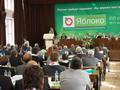
Photo: Yabloko Chairman Nikolai Rybakov at Yabloko’s seventh Charity Auction in support of political prisoners’ families / Photo by the Yabloko Press Service
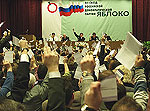
On Thursday, 13 November, Yabloko’s charity Auction in support of political prisoners’ families took place in Moscow. The auction was held both in person and online across Russia. Over almost six hours of bidding, 28 lots were sold: books, paintings, photographs, collectible items, excursions and personal meetings with famous people. The amount collected in one evening was 1,183,000 roubles, however the final results have yet to be tallied, as collection of voluntary donations within the framework of the auction, but outside bidding for lots, continues.
All proceeds will be transferred to relatives of eight political prisoners for whom Yabloko announced collection within the framework of the event in advance. These are families of people convicted or awaiting trials in politically motivated criminal cases:
– Anna Alexandrova, hairdresser from the Leningrad Region; convicted on denunciation for “fakes” about the army for five years and two months, her case is at the appeal stage;
– Anna Arkhipova, student from Novosibirsk; arrested for “fakes” about the army and on charges of “serious” crimes, including extremist crimes;
– Dmitry Bogmut, employee of St Petersburg Institute of Nuclear Physics; arrested for “fakes” about the army;
– Maria Bontsler, lawyer from Kaliningrad; arrested for “confidential cooperation with a foreign state”;
– Anastasia Zibrova, dog handler from the Moscow Region; convicted for “fakes” about the army for five years, her case is at the appeal stage for the second time;
– Maxim Kruglov, politician from Moscow, Yabloko Deputy Chairman; arrested for “fakes” about the army;
– Alexander Nozdrinov, activist and blogger from the Krasnodar Region; sentenced for “fakes” about the army to eight years and six months’ imprisonment;
– Antonina Favorskaya, journalist from Moscow; convicted for “participation in activities of an extremist organisation” for five years and six months, her case is at the appeal stage.

Photo: Kirill Goncharov presents lots from the personal collection of artist Maria Voloshchuk / Photo by the Yabloko Press Service
Opening the Auction, Moscow Yabloko Deputy Chairman Kirill Goncharov noted that there were more than a thousand political prisoners in Russia at present, the majority of whom are convicted for “fakes” and “discrediting the army”:
“These are novelties of our legislation that appeared after 2022. The meaning of such widespread use of these articles is to intimidate absolutely everyone, to shift people’s free speech into kitchens and preferably in whisper. But in our country’s history this has already happened; it ended contrary to the expectations of the authors of this idea.”
This is Yabloko’s seventh Auction in support of political prisoners’ families. The event was held for the first time in 2019 and raised 220,000 roubles for activists who went out to Moscow protests. The majority of collection addressees were widely known, as their names were in the news in connection with peaceful protest actions in Russia’s capital and throughout the country. Over three years the situation has changed: the term “political prisoner” has become no longer connected with civic activists and champions known to society — more often these are random people who have never previously participated in politics: students, teachers, journalists, lawyers, engineers, doctors, musicians, pensioners and even former police officers.
Speaking at the Auction, Yabloko Federal Political Committee Chairman Grigory Yavlinsky gave precise and shocking figures: “As of 7 November there are 1,164 political prisoners in Russia. From 19 September to today, the number of prisoners has grown by 53 people. So that you understand what is happening.”

Photo: Grigory Yavlinsky at Yabloko’s seventh Auction in support of political prisoners’ families / Photo by the Yabloko Press Service
Grigory Yavlinsky spoke about criminal prosecution of Yabloko deputy chairmen —about Maxim Kruglov’s case in Moscow and Lev Shlosberg’s two cases in Pskov, then reminded: party members Mikhail Afanasyev from Abakan, Vladimir Yefimov from Petropavlovsk-Kamchatsky, Vasily Neustroyev from St Petersburg, and Konstantin Smirnov from Ryazan remain in detention. Since the beginning of 2022, criminal cases have been opened against 11 Yabloko members.
Grigory Yavlinsky presented his lot within the framework of the event — a book by Professor of Theology Frederic Farrar “The Life and Work of Saint Paul the Apostle”:
“Saint Paul the Apostle helps in finding faith, strengthening spirit and searching for the true path, and in strengthening true friendship. He directed all his efforts towards healing from mental and physical ailments, alleviating pain and saving from premature death. It is precisely to him one should appeal for protection from ill-wishers and strengthening in moments of spiritual doubts. Therefore I offer you this book.”

Photo: The lot from Grigory Yavlinsky’s personal collection ultimately became the most expensive of the entire Auction and was sold for 300,000 roubles / Photo by the Yabloko Press Service
Yabloko Chairman Nikolai Rybakov, who invariably participates in the party’s auctions both as donor and as buyer, presented for the seventh Auction his painting “PEACE”. He painted it specially for the event and during his speech recounted that the work was born in stages, layer by layer, like milestones in the history of political repressions in the country: here are both dark times, the Great Terror, and the gradual “clarification” of public consciousness — understanding that killings are impossible. Inadmissible. Here in blue layer are words carved on the memorial of the Sandarmokh execution ground — “People, do not kill each other” and a new, black layer, and on it the purest, clearest and most honest, in white, the hope for peace.
“After 24 February 2022, everything to which our work and life is dedicated is the return of peace. So that killing of people is stopped. So that our country has a chance at a future. The absolute majority of today’s political prisoners have suffered for such work, for their words and publications. When we hold evenings of writing letters to political prisoners every month in Moscow and throughout the country, and people participate in such evenings — this is a common cause for the return of peace and freedom. So that there will no longer be political prisoners in our country,” Nikolai Rybakov said during his speech at the Auction.

Photo: Nikolai Rybakov’s painting “PEACE” went for 45,000 roubles / Photo by the Yabloko Press Service
In addition, Nikolai Rybakov read part of a letter that on 13 November, on the day of the Auction, he symbolically received from a friend—electoral expert Grigory Melkonyants, convicted in a political case to five years’ imprisonment:
“Chinese wisdom warns: God forbid living in an era of change. And [popular singer and song writer of the perestroika era] Viktor Tsoi sings about changes that our hearts demand. For me, changes are always for the better, whilst for the worse there can only be alterations. So changes for the better are coming.”
Attached to the letter were coasters (see photo below): “changes are coming” is written on their front side and “for the better” on the reverse. It also ran: “cardboard from processed cheese packaging, ballpoint pen, remand prison No. 2, Republic of Karelia, September 2025.”

Photo: Nikolai Rybakov shows coasters made by Grigory Melkonyants / Photo by the Yabloko Press Service
Many letters were read out that evening.
One of them was from imprisoned student Anna Arkhipovam it was read out loud by her friend Yelena:
“Today our cell woke up completely without strength. Grey sky. Drizzle. We are engulfed by an atmosphere of despondency and hopelessness. No one can or wants to do anything. We simply wait for another day of imprisonment to end. And then a familiar voice in the corridor says that letters are brought. The atmosphere changes dramatically: we smile, laugh, and I dance. They remember us and wait for us. For any prisoner it is important to realise that life does not end, that in freedom there is someone to whom you are dear.
Support from outside means a proof that the world cares about you. When heavy thoughts roll in, this becomes your lifeline: someone needs me, I will hold on.
Political prisoners have not killed anyone, have not committed evil, yet they are called criminals. Your support is a hand on the shoulder and the words ‘I know you are a good person, I am with you’. We are with you too. Although bars separate us, we are all citizens of one country, united in the impulse to see it free, peaceful and happy. It is a pity I cannot embrace everyone. But whilst I have a voice, I will say: everything will definitely work out. Believe in it. Peace to you, friends. Peace, love and good books.”
Another letter, from Yabloko Deputy Chairman Maxim Kruglov, was read by his lawyer Natalia Tikhonova:
“Friends! I sincerely thank you for helping today’s political prisoners. This solidarity cannot be overestimated. Such solidarity is perhaps one of the last forms of resistance we have now. However, if we speak and think about the future of our country, and we cannot help but think about it, then our mutual assistance, mutual aid and solidarity are that important reserve that will help us in building a new Russia. A Russia in which people who read books will tell people in uniform how to live, and not the other way round. A peaceful Russia of creativity, law and Christian values.
Let us remain compassionate and selfless people — for the sake of our country in which our children will live. Solidarity is our common resource to move towards such a future. Resisting the darkness of the present. Help each other. Help Yabloko. You see yourselves this is the only party of peace and freedom. More than ever we need your support. Without mercy and compassion, the country will have no future.”

Photo: Collection of Maxim Kruglov’s poems, published specially for the Auction on 13 November / Photo by event organisers
Persecution of Maxim Kruglov is politically motivated; he must be free and return to his work and his family as soon as possible, Natalia Tikhonova concluded her speech. Then Maxim’s mother Yelena Nikolayevna came to the podium. She spoke about her son’s childhood, recalled touching moments: how he released fish “because they should be free,” how he drove flies out the window — to freedom, how he protected every cat that sat on a car wheel in the courtyard of the house.
“He was always sensitive to justice. He has had pathological kindness since birth. That he is now behind bars is some monstrous injustice. He is exceptionally peace-loving. I ask you to support my son. On 9 December it is his birthday. Thank you,” Yelena Nikolaevna said through tears.
It should be noted that Maxim Kruglov has been deprived of liberty since 1 October, he has been charged with disseminating “fakes” about the army. He is now in remand prison No. 2 Butyrka. At the Auction he was not only among the political prisoners whose families participants of the event could support, but also became a donor himself — a collection of Maxim Kruglov’s poems, published especially for 13 November, was sold for 60,000 roubles.
Such an amount, 60,000 roubles, and more often it is even higher — 80,000 or 100,000 roubles —is a monthly necessity for a person in detention. Most prisoners simply do not have such money and, unfortunately, almost no one knows how expensive it is to live in a remand prison or penal colony: medications, normal food at least occasionally from a shop rather than from the canteen, lawyers, documents, examinations… Oskar Cherdzhiev spoke about this in his speech; he is defending dog handler Anastasia Zibrova. It should be recalled that she was sentenced for “fakes” about the army to five years’ imprisonment. Then the sentence was overturned, but upon reconsideration the court again imposed the same term on her.
“Anastasia possesses virtually all positive qualities imaginable,” Oskar Cherdzhiev said. “Every court hearing, and she was then under house arrest, she prepared pies and brought them to court — for me and journalists. But today I would like to say that the conditions in which she is serving her sentence — and I have been observing this in dynamics for a year — have worsened and are getting worse. People who were not prepared for the fact that they would become political prisoners find it increasingly difficult to endure such conditions. And support from outside is very important. Anastasia has no relatives who could help her; she has an aunt who supports her. But the rest comes from people, sometimes even strangers.”
Among the most expensive were lots from film director Andrei Zvyagintsev — a clapperboard from filming the new film “Minotaur” and the book “Leviathan: Breakdown”. They were bought for 150,000 roubles.

Photo: Andrei Zvyagintsev’s clapperboard / Photo by event organisers
The lot from astrophysicist and science populariser Sergei Popov — a book by Nobel laureate, theoretical physicist Kip Thorne “Interstellar” with the author’s autograph —was bought for 70,000 roubles.
The two-volume set by Efrosinya Kersnovskaya, an absolutely unique lot, the first Soviet comic drawn in the GULAG and released in minimal print run specially for the Auction, was provided by Novaya Gazeta newspaper. The lot was sold in minutes for 50,000 roubles.
It is worth emphasising that books at the Auction were one of the most popular types of lots. Thus, economist Ruslan Grinberg’s book “Freedom and Justice. Russian Temptations of False Choice” was sold at auction for 35,000 roubles. The author, presenting the lot personally, characterised the book as the path of a country that from century to century either chooses justice but sacrifices freedom, or chooses freedom but sacrifices justice. “All the time it’s the power of darkness or the darkness of power,” Ruslan Grinberg concluded.

Photo: Ruslan Grinberg at Yabloko’s seventh Auction / Photo by the Yabloko Press Service
Antique books, including in German, were donated to the Auction by Konstantin Smirnov, Chairman of the Ryazan regional branch of Yabloko and member of the party’s Federal Bureau. He is currently under criminal prosecution for alleged extortion and is recognised as a political prisoner. Thus, “All Quiet on the Western Front” by Erich Maria Remarque in German was published in the year the novel first came out. The book came to Smirnov in Münster. The second lot was a book that managed to be published in the Soviet Union in 1936, before the actual ban on Remarque several years later — “The Road Back”. Both books were sold as one lot for 50,000 roubles.
In addition, writer Mikhail Zygar and priest Alexei Uminsky provided their books to the Auction; the latter also gave parting words and blessed all participants of the event. Writer and historian Anton Utkin donated to the Auction a collection of Yury Kazakov’s stories “Blue and Green”. Yabloko Federal Political Committee Chairman’s adviser and human rights defender Viktor Kogan-Yasny provided for the Auction his essay “Provincial Pamphlet on Public Good” and a book with memoirs of doctor Lidia Grinshpun “About Life. About Profession”.
The second most popular type of lots — paintings and photographs — were provided to the Auction by artists Yulia Pavlova, Lika Merlow, Alena Zhilinskaya and Maria Voloshchuk, as well as Anonymous Artist and comic artist Irina Prikhodko.
Three lots at once — a triptych of photographs “Shepherd of Philanthropy” — were donated to the Auction by Lev Shlosberg’s wife Zhanna. These are photo-portraits of Father Pavel Adelgeim, taken by Lev Shlosberg in Pskov in 2011. Father Pavel was a priest, political prisoner of Soviet times, enlightener and human rights defender, church publicist, and public figure. The photographs were taken near the Church of the Holy Myrrh-Bearing Women, where Father Pavel served. In front of the entrance to the church territory and the historical cemetery adjacent to it, in 2007 a Foundation Stone was installed at the site of the future memorial to victims of political repressions.

Photo: Portraits of Father Pavel Adelgeim, taken by Lev Shlosberg in Pskov in 2011 / Photo by event organisers
It should be noted that several dozen photographs of Father Pavel taken by Lev Shlosberg in 2008-2011 became widely known during the priest’s lifetime, and after his death in 2013 entered virtually all books about the deceased pastor.
There were also lots quite unusual but very memorable for donors and desirable for participants, for example, a glass holder from oncologist Ilya Fomintsev and his daughter Mira. The glass holder travelled the world with the family for many years, went through four emigrations and became a true talisman against difficulties and illnesses. Now it will protect one of the Auction participants and help political prisoners.
But that was not all. A walk through Moscow’s secret courtyards with public figure Yelena Panfilova, a meeting with literary critic Galina Yuzefovich, a conversation with educator Dima Zitzer and a gingerbread from the Seliger forum (but also pleasant additions in the form of three scarves and a Seliger map, from the popular forum of 2000s) — all this became Auction lots that brought in an impressive part of collections.
The results of collections have yet to be tallied, when reception of voluntary donations ends within the framework of the Auction but outside bidding. This is standard procedure for conducting the event, which since 2019 were held first once a year, and then every six months. What remains unchanged is the wish of organisers, which during the seventh Auction was repeated by both donors and participants: “We dream that such auctions would take place as infrequently as possible or not at all; we dream that there would be no political prisoners. But whilst they exist, there will be such events.”
Posted: November 14th, 2025 under Charity, Freedom of Speech, Human Rights.