


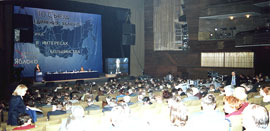


“Continuing to defend the truth”: Yabloko’s nationwide marathon in memory of the victims of political repression
Press Release, 30.10.2026

Photo by the Yabloko Press Service
On 30 October, the Day of Remembrance of the Victims of Political Repression, Yabloko is holding its nationwide marathon of reading out loud the names of the dead, “People, Do Not Kill Each Other!”. As every year, the event began early in the morning and will continue until late in the evening, bringing together dozens of regions and thousands of participants across the country. The marathon is taking place online, but in Moscow, St. Petersburg, Veliky Novgorod, Pskov, Karelia, Vladivostok and many other Russian cities, people can join it in person: they can come to the party’s offices and read out loud, live on air, the names of the innocent victims of the Great Terror who were convicted and shot during Stalin’s period.
In 2026, Yabloko is holding the “People, Do Not Kill Each Other!” marathon for the fourth time. Since the authorities banned the annual public reading of names, first in Moscow and then in the regions, the event has moved online and has become established as an alternative way of honouring the memory of all victims of political repression.
As is now a tradition, Yabloko members laid flowers at mass burial sites on the Day of Remembrance of the Victims of Political Repression.
It should be noted that Yabloko’s memorial events began before the Day of Remembrance of the Victims of Political Repression, 30 October. On 27 October, flowers were laid in Vladivostok at the monument to the victims of political repression on the Sedanka Pass. On 28 October, Moscow hosted a large public talk entitled “The Great Terror in the USSR: 90 Years On”, with speeches by human rights defender Jan Rachinsky, historian Nikita Petrov and Yabloko Chairman Nikolai Rybakov. On 29 October, Tatarstan Yabloko held an event entitled “Their Names Must Be Heard”, at which activists, party members and supporters took turns to read out loud the names of people from Tatarstan who had suffered from political terror.
Photo: The public talk “The Great Terror in the USSR: 90 Years On” / Photo by the Yabloko Press Service
Most of Yabloko’s events marking the Day of Remembrance of the Victims of Political Repression took place on 30 October.
At 10 am, Yabloko Chairman Nikolai Rybakov, Deputy Chairman Vladimir Dorokhov and Chief of Staff Yevgenia Vlasova laid flowers at the Solovetsky Stone in Moscow. The party leader read out the case file of Alexei Prokhorov, the grandfather of Boris Misnik, Coordinator of Yabloko’s Political Committee, who died in 2021.
Photo: Nikolai Rybakov, Yevgenia Vlasova and Vladimir Dorokhov at the Solovetsky Stone in Moscow on 30 October 2026 / Photo by the Yabloko Press Service
Nikolai Rybakov pointed out that today, the enemies of freedom are rehabilitating the executioners: Joseph Stalin, Lavrenty Beria and all the Chekists (officers of the secret service) whose hands carried out the political killings.
“The plan for the ‘slaughter’ of the people was in operation for many years. Today, behind a screen of pseudo-historians’ opinions, we are told that the repressions were necessary, that ‘you can’t make an omelette without breaking eggs’, that there weren’t that many innocent people, and other such nonsense. Meanwhile, historical facts are being hushed up, monuments to Stalin are being legitimised, and such ‘opinions’ are coming to the fore and replacing facts. Do you think a new ‘terror’ won’t affect you? Meanwhile, Yabloko continues to defend the truth, read out loud the names of those who were unjustly convicted, and demand freedom for today’s political prisoners. As long as their names are heard and their fate behind bars is known, there is hope.”
After returning to Yabloko’s central office, Nikolai Rybakov opened the party’s nationwide online marathon “People, Do Not Kill Each Other!”. It should be noted that the event takes its name from the inscription on the bas-relief at the entrance to the Sandarmokh memorial complex in Karelia, the place of mass executions during the Stalin period. The words were written by Yuri Dmitriev, a 70-year-old historian and researcher of Stalin’s repressions, who is also a political prisoner in present-day Russia, serving a long prison sentence.
Photo: The names, portraits and stories of victims of Soviet repression displayed in the hall of Yabloko’s central office / Photo by the Yabloko Press Service
The reading of the names of victims of Soviet repression was opened by Ivan Bolshakov, a member of the party’s Federal Political Committee and head of Yabloko’s Analytical Centre. Then activists, supporters and members of Yabloko all over Russia took turns to read out loud the names of those who had been killed and convicted.
Members of Moscow Yabloko took an active part in the marathon, including Kirill Goncharov, Chairman of the branch, Yuri Shein, Deputy Chairman of the branch, and Andrei Lazarev, a member of the regional branch’s Bureau. Alexander Gnezdilov, a member of the party’s Federal Political Committee, and astrophysicist Sergei Popov also joined the event in person at the party’s central office.
Photo: Sergei Popov speaking during Yabloko’s “People, Do Not Kill Each Other!” marathon / Photo by the Yabloko Press Service
Historian Anatoly Razumov also took part in Yabloko’s “People, Do Not Kill Each Other!” marathon. For many years, Razumov has headed the Returned Names Centre at the National Library of Russia. He is also the compiler of the Leningrad Martyrology and the editor and compiler of Yuri Dmitriev’s book “Sandarmokh: A Place of Memory”. For decades, Anatoly Razumov has been restoring the names and fates of the victims of Soviet terror.
Saratov, Stavropol, Krasnoyarsk, Pskov, Tula, Chuvashia, Karelia, and Ingushetia: these and many, many other regions joined the “People, Do Not Kill Each Other!” marathon throughout the day. Thousands of people across the country read out loud the names of victims of the terror, and many shared personal stories that had touched their own families.
Photo: Nikolai Rybakov in Yabloko’s studio during the marathon / Photo by the Yabloko Press Service
ST. PETERSBURG
St. Petersburg Yabloko paid tribute to those killed and tortured by the state machinery of Soviet terror. On the morning of 30 October, party members and supporters laid flowers at the Solovetsky Stone on Troitskaya Square, and then at the Levashovo Memorial Cemetery, where, according to various estimates, the remains of between 19,450 and 46,771 innocent citizens killed by the Soviet authorities lie buried.
Photo: The St. Petersburg Yabloko delegation at the Solovetsky Stone
The events were attended by Alexander Shishlov, Coordinator of the party’s Federal Political Committee; Dmitry Anisimov, Chairman of St. Petersburg Yabloko; his deputy Yegor Karpenkov; David Zudin and Yegor Kravtsov, members of the regional branch’s Bureau; and other party members and supporters.
“Each of the hundreds of thousands of people tortured by state executioners, whether a poet who was shot, a scientist who was exiled, a priest who was killed or a peasant who was dispossessed as a kulak (well-to-do farmer), is a broken thread of a human life and of the country’s history, and an eternal reminder of the monstrous price of usurping power and hunting for ‘enemies of the people’,” said Dmitry Anisimov.
Photo: The St. Petersburg Yabloko delegation at the Levashovo Memorial Cemetery
“When 30 October, originally the Day of the Soviet Political Prisoner, became an official day of remembrance in 1991, it seemed that political repression would remain in the past for ever. Sadly, in our country people are once again being persecuted for their words and beliefs, and the list of political prisoners is growing. That is why today it is especially important to remember the terrible lessons of our history, so that the tragedy is not repeated,” said Alexander Shishlov.
VELIKY NOVGOROD
Novgorod Yabloko held an authorised rally in memory of the victims of political repression on Bolshaya Moskovskaya Street on 30 October from 3 pm to 5 pm. Those attending not only paid tribute to the victims but also read their names out loud, including live on air during the nationwide “People, Do Not Kill Each Other!” marathon.
Photo: Novgorod Yabloko’s rally
“In 2023, on this day, we remembered the names of the people of Novgorod who were shot in Novgorod; in 2024, we paid tribute to those repressed in Borovichi; and in 2025, in Staraya Russa. In total, almost 60,000 people were repressed in the Novgorod Region, 7,114 of whom were shot,” Novgorod Yabloko said.
On the day of the rally, Novgorod Yabloko and its supporters also demanded freedom for today’s political prisoners, who, sadly, include many of their fellow party members.
Photo: Anna Cherepanova, Chair of Novgorod Yabloko, and Viktor Shalyakin, head of the Yabloko faction in the Novgorod Regional Duma / Photo by Novgorod Yabloko
The participants came to the rally holding placards in support of the party’s Deputy Chairmen Lev Shlosberg and Maxim Kruglov, both of whom have been deprived of their liberty for their peaceful convictions.
Photo: Novgorod Yabloko
During the “People, Do Not Kill Each Other!” broadcast, Igor Yakovlev, head of the party’s press service, talked about his project Return of Photographs. Bound volumes of Soviet newspapers from the 1930s contain thousands of photographs of people whom the state first glorified as heroes of labour and then, during the Great Terror, declared “enemies of the people”. Since 2024, Igor Yakovlev has been studying the bound volumes of Vostochno-Sibirskaya Pravda, a newspaper published in what is now the Irkutsk Region, the Trans-Baikal Territory and Buryatia. He adds the photographs and biographical details he finds to the records of repressed people on the Open List website, restoring to them not only their names but also their faces.
IRKUTSK
On 30 October, Irkutsk Yabloko held a reading of names at the memorial in the village of Pivovarikha.
“This is a very grim place, where the bodies of residents of our region who had been shot or tortured to death were brought. The bodies were thrown into so-called collection ditches and covered with 30–40 cm of earth. The exact number of people buried here is still unknown. Relatives of those whose names have been restored put up memorials here and bring flowers,” the Irkutsk branch of Yabloko said.
Photo: Irkutsk Yabloko
KIROV
More than a hundred people took part in an authorised rally in memory of the victims of political repression in Kirov on 30 October. Party activists and supporters gathered at the Solovetsky Stone on Grin Embankment to read out loud the names of victims of the Great Terror and to express support for today’s political prisoners.
Photo: Kirov Yabloko
REPUBLIC OF KARELIA
On 30 October, leaders and activists of Karelian Yabloko read out loud the names of victims of Soviet repression at Zaretskoye Cemetery in Petrozavodsk. Those gathered there also joined the live broadcast of the “People, Do Not Kill Each Other!” marathon.
Photo: The Karelian Yabloko delegation
“We read out loud the names of those shot near Petrozavodsk in 1937–1938. Dozens of names of murdered residents of Karelia were read out loud during the broadcast of the nationwide marathon in memory of the victims of repression, ‘People, Do Not Kill Each Other!’. We remember and will continue to remember, so that the tragedy is not repeated!” said Emilia Slabunova, a member of the party’s Federal Political Committee and Chair of Karelian Yabloko.
Photo: Ivan Bolshakov, a member of the party’s Federal Political Committee and head of Yabloko’s Analytical Centre, on air during the “People, Do Not Kill Each Other!” marathon. He took over from Nikolai Rybakov as host on the evening of 30 October / Photo by the Yabloko Press Service
CHELYABINSK
On the morning of 30 October, leaders and activists of Chelyabinsk Yabloko visited the Golden Mountain memorial complex in Chelyabinsk, a site of mass graves of victims of Stalin’s political repressions of the 1930s.
“Golden Mountain is one of the largest burial sites of victims of political repression discovered in our country,” said Yaroslav Shcherbakov, Chairman of Chelyabinsk Yabloko. “The memory of the victims must be preserved so that this never happens again. Unjust court rulings, the killing of the state’s own citizens: we are working to make sure this never happens again, so that there is no political repression and there are no political prisoners.”
Photo: The Chelyabinsk Yabloko delegation / Photo by the regional branch of the party
On the evening of 30 October, the Southern Urals also took part in Yabloko’s “People, Do Not Kill Each Other!” marathon. This was followed in Chelyabinsk by a lecture by renowned local historian Yuri Latyshev on the history of the Great Terror in the capital of the Southern Urals and the places connected with the repressions of 1937–1938.
Photo: Yuri Latyshev / Photo by Chelyabinsk Yabloko
In 2025, the marathon lasted nine hours. You can find out how last year’s event went here (https://www.yabloko.ru/cat-news/2025/11/01 ).
Posted: October 30th, 2026 under Conferences and Seminars, Freedom of Speech, History, Human Rights, Yabloko's Regional Branches.