




Maxim Kruglov: “It is a Russian tradition to hack off one of the heads of the two-headed eagle in the Russian coat of arms with a vengeance, and today we are watching exactly that”
Press Release, 31.08.2026

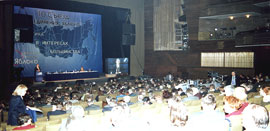
Photo: Maxim Kruglov addressing the Moscow City Court via video link / Photo by Irina Vorobyova
During a break before the appeal panel announced its decision, those who had come to support Maxim Kruglov were let into the courtroom. He addressed those present via video link. His speech was interrupted when the judges entered the courtroom and announced their decision — to leave the seven-year sentence unchanged.
We publish the full transcript of Maxim Kruglov’s speech:
— I see no point in taking part in closing arguments, or in formulating some kind of last word. I have no illusions about the outcome of today’s decision — it’s all clear. I think the panel of judges is in no position to change a decision that has already been decided in advance, and indeed it isn’t within their power to do so. In that sense, paradoxically, they themselves are, in a way, victims of this situation, of these circumstances. Well, what can one do. In any case, I wish them all the best, quite sincerely, whatever they decide today.
Unfortunately, that is the historical and political situation our country finds itself in at present. It is an unfortunate political moment, one that will certainly change. We can see that this summer an enormous need emerged among people for life to return to normal, a need for peace.
A huge number of Russians felt able to state openly that they do not consider the tragedy — the loss of life — that has now been going on for four and a half years to be normal. They spoke out for life to return to normal, for a life without fear, for people no longer being imprisoned for their positions or their words, and for wanting to see their views and their need for normal life represented politically in the State Duma.
To be honest, this makes me very happy, and I am very proud of it. And being here, I have seen, well, some meaning in my own work, in the work of our colleagues, in the work of my friends in this surge of civic engagement, civic self-respect, this moral position declared by millions of Russians. That means it was not all in vain, that means there has been, is and will be a sufficiently deep and meaningful purpose in this for our country.
Unfortunately, Yabloko’s subsequent removal from the elections, my own sentence, and the monstrous sentence handed down to Lev Shlosberg show that those making the decisions have chosen, firstly, to ignore this demand for change, for normal life. And secondly, to ban it, criminalise it, and, in effect, make it clear to society that the next step for such dissent, for such a wish, may well end in the very space I am in, the space my friend and my colleague Lev Shlosberg is in, along with Pavel Syutkin, the food historian and my neighbour here at the Butyrka pre-trial detention facility, and hundreds of other political prisoners.
On the one hand, one could say that the charges brought against us are entirely absurd, entirely wrong. But if you look at the logic behind it — that the authorities have decided to equate dissent with hatred, and accordingly, in accordance with the precepts of Jean-Jacques Rousseau, to destroy dissent by destroying dissenters as a phenomenon that threatens their departmental interests, and their power — if you look at that wider context, then it is all more or less logical. It is all more or less understandable, however unpleasant, regrettable and, perhaps, tragic it may be if it continues to spread exponentially.
In that sense, the authorities have decided to ban the demand for change, for a return to normal life. But it isn’t that simple — you cannot simply ignore the opinion of millions of Russians. You cannot simply ban the future that is, in this sense, taking shape, being formed. And this kind of reaction, in my view, is entirely ahistorical, it is unpatriotic, it lies within the framework of a very poorly understood pseudo-patriotism. Or rather, it doesn’t even lie within that framework, but within one of departmental interests that are very poorly, wrongly and selfishly understood. Because, judging by what is happening, it is people in uniform who are today making political decisions, decisions of this magnitude: how to ignore the demands of citizens, the demands of young people, to deprive them of political representation, and demonstrate, as a warning to others, that dissent — as it is written in my own sentence — is now equated with a motive of political hatred, and therefore with prison.
So, in that sense, it is, unfortunately, indeed logical. And, unfortunately, there is nothing new about this in Russian history. It happens when one part of the country — let’s call them, for the sake of argument, ultra-patriots, in some measure people in uniform who hold unlimited power and are unrestrained in their poor understanding of their own departmental interests — clings to power, clings to the preservation of that power, and fights against a diversity of opinion, against the country’s diversity, against another part of Russia, rejecting the plain understanding that a country’s strength, its integrity, lies precisely in the fact that the country is diverse, that it will always contain different people with different political views, sometimes fundamentally different, sometimes diametrically opposed to one another. And that is normal. That is precisely what makes up the country’s diversity and the country’s integrity, from which it can draw its resources for the future, for a return to normal life, peaceful coexistence with its neighbours, and a life without fear.
And in that sense it is really symbolic that our coat of arms, the two-headed eagle, always looks in different directions. And that is not a problem. It is our resource, and it is our strength. Unfortunately, it is very much a Russian tradition to hack off one of those heads with a vengeance, and today we are, in effect, watching exactly that.
They have decided that the desire for peace is a threat, that the desire for a life without fear is recognised as a threat, that creativity and freedom are recognised as threats. And these so wrongly and poorly understood departmental interests, for the sake of which this inseparable and significant part of Russia is being destroyed, in my view, put its future and its fate at risk.
And here, in this sense, indeed, as Grigory Yavlinsky, Yabloko’s founder, rightly noted in his piece [on Yabloko’s removal from the elections], this is not about the fate of the Yabloko party, not about my own fate, not about the fate of Lev Shlosberg, not about the fate of other political prisoners — this is truly about the fate of the country.
We are quite genuinely at a historical juncture, at a crossroads, if I may put it that way, at a point of bifurcation. And I think it important to note that we must stop destroying diversity in this country, stop destroying free creativity, stop destroying people’s desire to express a normal human and Christian moral position.
It is precisely this kind of destruction that “divides a kingdom against itself,” as it is put in the Gospel: “If a kingdom be divided against itself, that kingdom cannot stand”. Unfortunately, that phrase is often understood in a very primitive and distorted way — as though all dissent must be banned in order for the kingdom to stand. But it is all far more complex, far more diverse than that. The divine diversity given to our country is a tremendous asset. And destroying that diversity is precisely what constitutes a crime against the country, and a dividing of that kingdom.
Such a surge of interest in the Yabloko party, such solidarity around us, around our very concise, clear, simple and understandable platform — for peace and freedom, for a ceasefire agreement, for a life without fear, for people no longer being imprisoned for their position, their words, their opinions — that is what such a huge number of people responded to, because millions of our fellow citizens…
[Speech interrupted by the arrival of the judges.]
Posted: August 31st, 2026 under Elections, Freedom of Speech, Governance, Human Rights, Judiciary, Regional and Local Elections, Regional and Local Elections 2026, State Duma Elections, State Duma Elections 2026, Yabloko's Regional Branches.