


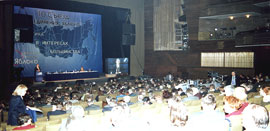


The 1996 presidential election: 30 years on
Grigory Yavlinsky’s website, 1.07.2026
Watch on YouTube choosing your preferred language for subtitles or English for the sound track
Thirty years ago, in the presidential election, we tried to prevent the creation of a corporate oligarchic state in Russia and proposed ways of correcting the reforms of the first half of the 1990s, which had failed entirely. We stated publicly that, without this, the state would pose a threat both to the country itself and to Russia’s immediate neighbours.
In May 1996, during the election campaign, we, on behalf of the democratic opposition, offered a compromise to the authorities and to the political forces supporting Boris Yeltsin. This was not a personal compromise — not support in exchange for posts. It was a policy compromise. On 18 May 1996, platform demands to Yeltsin were published which could have formed the basis of a political alliance.
The package of proposals included a genuine end to the war in Chechnya, the adoption of a law introducing amendments and additions to the Constitution of the Russian Federation clearly delineating the powers of the president and the government, the observance of a balance of powers, limits on one-man rule, and a whole set of measures to address fundamental economic problems, above all to correct the consequences of criminal privatisation. It also envisaged raising the minimum wage to two-thirds of the subsistence minimum, lowering tax rates, and the immediate dismissal of a number of corrupt members of the government and administration.
The aim of my participation in the election was to come third in the first round (an outcome predicted by virtually all opinion polls), to support Yeltsin in the second round against [communist leader] Zyuganov, to obtain the post of prime minister, and to fundamentally correct the economic reforms that had by then failed. But to prevent this course of events, General Lebed was brought into the race as a candidate through manipulation; having come third in the first round, he backed Yeltsin, was appointed Secretary of the Security Council of Russia, and was dismissed from that post three months later.
Today, 30 years on, it is clear that the outcome of the 1996 presidential election not only failed to correct the failed economic reforms, but also deprived Russia of any prospects of forming genuine institutions of elections, parliamentarism and representative government as such. The merger of power and private property that resulted from the criminal loans-for-shares auctions of 1995 required that the ruling elite remain irremovable. Any raising of the question of the legality and legitimacy of the loans-for-shares auctions, and any measures restricting the ruling nomenklatura‘s freedom to dispose of property acquired by criminal means, was unacceptable to the new Russian elite. All proposals relating to fair market competition were rejected outright. And to keep Boris Yeltsin in power in the 1996 election, every resource of the state was deployed, including the subordination of almost all Russian media to the interests of the ruling authorities, as well as manipulation and falsification during the voting.
Grigory Yavlinsky
***
On the path our country has travelled over these 30 years, and what we have ultimately arrived at, Grigory Yavlinsky spoke in a new episode of the Frank Conversation series.
Posted: July 1st, 2026 under Elections, Governance, History, Human Rights, Political Parties, Presidential Elections, Privatisation in Russia, YABLOKO Against the Parties of Power, Без рубрики.