




Court sentences Yabloko Deputy Chairman Maxim Kruglov to seven years in a penal colony over two posts expressing regret at the loss of human life
Press Release, 24.06.2026

Photo: Maxim Kruglov in court on 24 June 2026 / Photo by the Yabloko Press Service
Today, 24 June, a judge of the Zamoskvoretsky Court of Moscow delivered the verdict in the criminal case against Yabloko Deputy Chairman Maxim Kruglov: guilty as charged, seven years in a penal colony, and a three-year ban on administering Internet resources. The verdict will be appealed, the politician’s lawyers announced. Yabloko has described the sentence as, at the very least, unjust.
More than a hundred people came to court to support Yabloko Deputy Chairman Maxim Kruglov, among them Yabloko Chairman Nikolai Rybakov, Federal Political Committee Chairman Grigory Yavlinsky, head of the Yabloko Analytical Centre Ivan Bolshakov, members of the party’s Federal Bureau, and members of the Bureau and activists of Moscow Yabloko. Many were unable to get into the courtroom, despite bailiffs bringing in additional benches and opening the door into the corridor: dozens listened to Maxim Kruglov’s last word from the doorway.

Photo: Grigory Yavlinsky (left) and Nikolai Rybakov (right) in court at the hearing in the case of Maxim Kruglov / Photo by the Yabloko Press Service
In his last word, the politician thanked the court “for the correctness with which the case was conducted, for its openness and transparency”. He emphasised that throughout his life and career he had been guided solely by “love for his country — a country where human life is valued”:
“…my distinguishing feature, and the distinguishing feature of my party — Yabloko — is that even when we criticise certain laws or disagree with them, we abide by those laws. That is our principled position. We work in accordance with the legislation of the Russian Federation. We operate within the legislative framework of the Russian Federation.”
Maxim Kruglov also noted that Article 207.3 of the Criminal Code on “fakes about the army”, under which he had been charged, was repressive, yet he had not violated it.
It should be noted that Maxim Kruglov has been charged under the so-called dissemination of “fakes” about the Russian Armed Forces (Article 207.3 of the Criminal Code), allegedly committed on “grounds of political hatred”. The basis for the charge was two posts on Telegram in which the politician expressed regret at the loss of human life in Ukraine. The prosecution had sought a sentence of eight years in a penal colony; defence experts had maintained that the politician’s messages contained no hatred and no indication of aggression whatsoever.

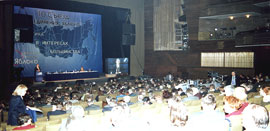
Photo: Members of the public before Maxim Kruglov’s last word / Photo by the Yabloko Press Service
Maxim Kruglov’s last word lasted approximately fifty minutes, after which all those present applauded loudly. Without interrupting Kryglov’s supporters and waiting for the applause to die down, the court announced a two-hour recess to prepare for the delivery of the verdict.
“Guilty as charged, seven years in a penal colony…”, the judge announced the verdict following the recess.
Bailiffs escorted the audience from the courtroom. So many people had gathered that they formed a human corridor. Through it, the convoy led Maxim Kruglov out of the building, again to loud applause, wishes of strength and endurance, and cries of encouragement that all obstacles could be overcome.
The court’s ruling has not yet entered into legal force. It will certainly be appealed, announced Kruglov’s lawyers, Natalia Tikhonova and Sergei Badamshin.
“The investigation and prosecution committed colossal violations,” said Natalia Tikhonova. “Maxim has a family, a young daughter, and he has chronic conditions that are life-threatening. All of this is documented in the case file. There is no corpus delicti in this case, but there is material demonstrating that Maxim should be free: two volumes of it, if not more. Acquittal should have been the only verdict handed down today.”
The sentence handed to Maxim Kruglov is a clear act of retribution by the authorities against a political opponent, declared Yabloko Party Chairman Nikolai Rybakov:
“Maxim has committed no crime, and has already spent nearly a year in the Butyrka prison. The investigation presented no evidence of ‘guilt,’ and the so-called ‘witnesses’ who appeared for the prosecution at the trial — activists of the party of power — would long since have been punished for perjury in any honest court.”
The entire proceedings in the Kruglov case amounted to “a demonstration of the decay of law enforcement and a regression to the era of Stalin’s Great Terror,” the Yabloko leader emphasised.

Photo: Members of the public in the court corridor during Maxim Kruglov’s last word / Photo by the Yabloko Press Service
The Moscow branch of Yabloko, in an urgent statement on the sentencing of party Deputy Chairman Maxim Kruglov, emphasised that the verdict was politically motivated and that “a judicial decision of this kind deepens the widening split in Russian society”. The statement also noted that during the hearing, the public prosecutor had “been compelled to acknowledge an error made by the investigation in the preparation of the bill of indictment”. Had the Kruglov case been heard by an independent and impartial court, the politician would have been acquitted, his colleagues stressed.
Kruglov received seven years in a penal colony “for openly expressing a humanist position, for words of compassion, and for citing official UN data on the loss of human life,” said Yabloko Analytical Centre head Ivan Bolshakov:
“Justice was replaced by a punitive sentence designed to intimidate those who dissent from the official interpretation of events. It was a show trial conducted against a political opponent whose principled position proved unacceptable to the authorities.”
A detailed chronology of the court proceedings is as follows:
The questioning of prosecution witnesses — United Russia activists Valery Somov and Alina Matveyeva — took place on 22 April and 6 May. The first witness (a political analyst from the state-owned municipal housing and utilities services organisation GBU Zhilishchnik, 25-year-old Somov) stated that he had been walking near Lubyanka Square [known by the FSB office situated there] and had happened to encounter a FSB officer, who had for some reason asked whether Somov knew Maxim Kruglov. The second witness (a volunteer of the pro-government the Young Guard youth organisation, 23-year-old Matveyeva) described an assignment she had received at university “to study how politicians speak about the special military operation,” and explained her reasons for filing a denunciation against Kruglov.
The questioning of defence witnesses took place on 3 June. The court questioned Yabloko Federal Political Committee Chairman Grigory Yavlinsky. “Kruglov is a patriot of Russia; there has never been any motive of political hatred in his activities,” Yavlinsky stated.
The same was affirmed by the defence expert witnesses — philologist Igor Zharkov and psychologist Veronika Konstantinova, who had conducted a psychological and linguistic analysis of the social media posts that had served as the basis for the criminal proceedings. In Kruglov’s posts, the experts found only “very cautious, very measured” expression of personal feeling, and identified no signs of inter-group confrontation or conflict, nor any incitement to hatred, nor any use of hostile language.
The questioning of Maxim Kruglov and the closing arguments of the parties took place on 17 June. Maxim Kruglov quoted his own words on his attitude to the special military operation, spoken during his first night-time interrogation: “The armed conflict is a tragedy; the loss of human life must be stopped. This is a great sorrow. A ceasefire agreement must be concluded as soon as possible”. That same day, the prosecution requested a sentence of eight years in a penal colony for the politician.
Posted: June 25th, 2026 under Freedom of Speech, Governance, Human Rights, Judiciary, Yabloko's Regional Branches, Без рубрики.