




‘The prosecution speaks of political, national and social hatred’: the Maxim Kruglov case continues in Moscow
Press Release, 6.05.2026

Photo: Maxim Kruglov in court on 6 May 2026 / Photo by Darya Kornilova
The Zamoskvoretsky District Court of Moscow resumed proceedings in the criminal case of Maxim Kruglov, Yabloko’s Deputy Chairman, charged with disseminating “fake news” about the Russian Armed Forces (Article 207.3 of the Criminal Code) on 6 May. The politician has been held in custody since 1 October 2025 and is being prosecuted for two social media posts. On Wednesday, the court heard testimony from a prosecution witness, Valery Somov, a 25-year-old political analyst employed by the state-owned housing and utilities municipal services company Zhilishchnik, who, according to media reports, is a functionary of the ruling United Russia party. In court, Somov stated that he had once been walking near Lubyanka Square in the centre of Moscow when an FSB [the Federal Security Service of the RF] officer approached him and asked whether he knew Maxim Kruglov.
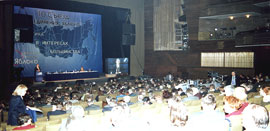
Kruglov’s family members, Yabloko Chairman Nikolai Rybakov, the party’s Moscow branch Chairman Kirill Goncharov, representatives of diplomatic missions, and dozens of colleagues and journalists came to the court on 6 May to support him.
The hearing opened with the judicial examination phase, during which assistant prosecutor of the Central Administrative District Yulia Guznyaeva read out the indictment. Among other things, she recalled that the President of the Russian Federation had, on 24 February 2022, “in fulfilment of the ratified treaties of friendship and cooperation between the Russian Federation, the DPR (the Donetsk People’s Republic) and the LPR (the Lugansk People’s Republic)”, taken the decision to launch the special military operation. In the prosecution’s submission, Kruglov had disagreed with this, set up a Telegram channel, and in April 2022 — “harbouring hatred” — had “decided to disseminate, under the guise of reliable information, deliberately false information” from the Yabloko office in Moscow: namely, posts concerning events in Bucha in the spring of 2022. Yulia Guznyaeva further alleged that Kruglov had counted on his own popularity and had harboured various forms of hatred when publishing the posts (two on Telegram and one on VKontakte), and had thereby “caused harm to the Russian Federation”.
Immediately after the prosecution’s address, Maxim Kruglov declared that the charges were confused, incomprehensible and vague: “On the one hand, the indictment refers to ‘political’ hatred, then to ‘national’ hatred, and then to ‘social’ hatred altogether. I am bewildered. I do not plead guilty.”
His defence counsel — barristers Natalia Tikhonova and Sergei Badamshin — supported Kruglov’s statement.
The witness examination then followed. Valery Somov, a 25-year-old Moscow resident, began: “I am not personally acquainted with Kruglov and do not approve of his course”. He then explained that, on his own initiative, he monitored “opposition information” on social media every day — a practice he attributed to his background in political science. It was in this capacity that, “in the spring or summer of that year, he came across a post about Bucha on VKontakte”, he said, clarifying later that he meant 2025. He had been working in the housing and utilities sector both then and now — currently at Zhilishchnik, he told the court.
“Do you have any grounds for making a false statement against Maxim Kruglov?” asked Judge Elina Babayants.
The witness hesitated and appeared flustered — seemingly caught off guard — and said, far less confidently and audibly than before: “No”.
His written testimony, however, given during the investigation in November 2025 and read out in court on 6 May 2026, indicated that Somov had found a link to Kruglov’s social media pages on the Yabloko party website. In court on Wednesday, he gave a different account: he said he had learned that Kruglov was a deputy [of the Moscow City Duma] from information on Maxim’s VKontakte page, i.e. “in the spring or summer” of 2025. It should be noted that Maxim Kruglov’s term as a Moscow City Duma deputy had expired in autumn 2024, and his social media pages in 2025 contained no indication that his work as a deputy was continuing.
Somov then recounted that — again, “in the spring or summer” of 2025 — he had been interviewed by the FSB at Lubyanka, but declined to answer who had summoned him or why.
“My friend and I were walking in the city centre when an FSB officer approached us and asked whether we knew Maxim Kruglov. I said yes,” Somov recounted, though he could not recall whether this had happened in spring or summer.
He added that he and his friend had been out for an evening walk after work, and, in response to a question from Sergei Badamshin, noted that when he left the FSB building after the conversation, it had still been light outside.
This account again contradicted his November 2025 testimony, in which he had stated that he and his friend had been walking near Lubyanka Square at noon or 12:30 on a working day. He could not recall the specific date. Whether he had taken time off work was never established, as the court struck that question from the defence.
Many of the witness’s answers amounted to an inability to recall details and circumstances of the events under discussion; yet Somov stated with confidence that he had assessed Kruglov’s posts as “immoral” and had even detected in them a “discrediting of the Russian government”.
Kruglov’s defence lawyer Sergei Badamshin asked the witness to explain why the records of his FSB interview and his Investigative Committee interrogation — conducted six months apart — were, according to the case materials, “word-for-word identical”, whereas he now consistently claimed to remember nothing. “A lot has happened at work and in my personal life,” the witness replied, after which the nearly two-hour examination concluded.

Photo: Some of the audience members and journalists in court on 6 May 2026, alongside Yabloko Chairman Nikolai Rybakov (right) / Photo by the Yabloko Press Service
By that point, several media outlets had published reports indicating that Valery Somov had direct ties to the [ruling] United Russia party — that he was the executive secretary of a local United Russia district branch in Moscow and had participated in the party’s Moscow primaries in 2024. Nevertheless, when responding to the defence’s questions on 6 May, Valery Somov maintained that, although he was studying for a master’s degree in political science, he did not lean towards any political party.
The hearing continued with an examination of the written materials in the case: Yulia Guznyaeva spent approximately half an hour listing pages from three volumes of the case file, dwelling in detail on an extensive list of positive character references for Maxim Kruglov. It should be noted that dozens of favourable testimonials — submitted to the court last autumn by Kruglov’s Yabloko party colleagues, political opponents, and prominent public figures, journalists, and human rights defenders alike — had attested to his good character.
Following the examination of the materials, the prosecution requested an adjournment. The trial will resume on 20 May.
It should be noted that on 21 May the Moscow City Court will hear an appeal against Maxim Kruglov’s detention; the politician is required under the Zamoskvoretsky Court’s ruling of 22 April to remain in pre-trial detention for at least a further six months.
Posted: May 7th, 2026 under Elections, Freedom of Speech, Governance, Human Rights, Judiciary, State Duma Elections, State Duma Elections 2026, Yabloko's Regional Branches.