




New lawsuit filed against Irkutsk City Administration over refusal to give a permission for the “Free Internet” and pro-Telegram rally
Press Release, 19 March 2026

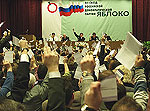
Photo by Sergei Konkov, Kommersant
On 18 March, Pavel Kharitonenko, an activist and Yabloko supporter, filed a lawsuit with the Kirovsky District Court of Irkutsk over the city administration’s refusal to approve a rally against the blocking of the Internet, certain messaging applications and services. Kharitonenko indicates in the lawsuit that constitutional right of the plaintiff to peaceful assembly, meetings, rallies and demonstrations, as well as the right to orgnise public events was violated
It should be noted that on 13 March, Kharitonenko submitted an application to the Irkutsk city administration for a “Free Internet” and pro-Telegram rally, with an expected attendance of up to 900 participants; the co-organiser was Grigory Gribenko, the leader of Irkutsk Yabloko. The administration’s response arrived on 16 March: the application was refused on the grounds that demands for free access to information and freedom of expression were unlawful.
The administration justified its refusal by citing Article 3, Clause 1, of the Law “On Rallies” (No. 54-FZ), which defines the principle of lawfulness as “compliance with the provisions of the Constitution of the Russian Federation, the given Federal Law, and other legislative acts of the Russian Federation”. The aim of the rally as stated by its organisers, according to the administration’s response, “violates the principle of lawfulness”.
The plaintiff notes in the lawsuit that whilst this article and clause do indeed exist in the Law “On Rallies”, they contain no provisions permitting municipal administrations to refuse approval for rallies.
Furthermore, had officials failed to understand the purpose of the proposed event, they were required under rulings of the Supreme Court of Russia to “initiate conciliation procedures” and invite the organisers to remedy any deficiencies, rather than issuing an outright refusal, the lawsuit runs.
It is also noted in the lawsuit that the Irkutsk city administration based its refusal on assumpions. For instance, the administration’s refusal stated that a rally in defence of the internet would “violate the legitimate interests of an indeterminate group of persons in connection with the dissemination of false information”. Yet the rally notification contained no mention whatsoever of disseminating any information during the proposed event.
“The purpose of the proposed rally is to express a civic position — that is, an OPINION on law enforcement practices relating to the blocking of Internet resources, as well as to put forward demands. A divergence between the applicants’ opinion and the official position of state authorities cannot constitute grounds for refusing to approve a rally, since an opinion — unlike information (data) — cannot be false,” the lawsuit emphasises.
The plaintiff therefore asks the Kirovsky District Court to:
- declare the city administration’s refusal unlawful;
- require the city administration to reconsider the rally application within one day of the date of the ruling;
- recover from the administration the court filing fee of 3,000 roubles.
“I wish to express my deepest gratitude to Alexander Kobrinsky, Deputy Chairman of the St. Petersburg Yabloko branch, who provided legal support, as well as to the Yabloko party,” Pavel Kharitonenko said.
Lawyer Alexander Kobrinsky, for his part, suggests that the Irkutsk city administration simply does not know how to handle the situation:
“On the one hand, the rally has to be banned, because the regional and federal authorities will not like it. On the other hand, there is no lawful pretext to object to anything. So they refused on the basis of assumpions, just to be safe: ‘What if you end up criticising the authorities? After all, everything they do is in accordance with the Constitution. So you must be unhappy with the Constitution?!'”
According to the case file on the court’s website, the hearing will take place on 25 March. The lawsuit will be heard by the same judge who presided over the lawsuit brought by Irkutsk Yabloko leader Grigory Gribenko against the city administration.
In that case Gribenko had challenged the administration’s refusal to approve a Yabloko rally that had been planned for 1 March. The administration had initially approved the event but subsequently withdrew its approval owing to the heightened interest among Irkutsk residents in the issue of Internet blocking in general, and the blocking of Telegram in particular. The court ruled in favour of the administration, and Gribenko is currently preparing an appeal against that decision.
Posted: March 20th, 2026 under Freedom of Assembly, Freedom of Speech, Governance, Human Rights, Judiciary, Yabloko's Regional Branches.