


Moscow Yabloko holds round table on the civil, political, and economic rights of Moscow residents
Press Release, 18.02.2026

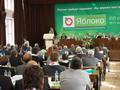
Photo: Round table on the rights of Muscovites / Photo by the Yabloko Press Service
On 17 February, the Moscow branch of the Yabloko party held an extensive round table devoted to the rights of Muscovites. Experts in economics, urban heritage protection, and the electoral and judicial systems gathered at the party’s office to address the central question: are the rights of Moscow residents a genuine instrument of protection, or represent merely fiction?
The round table was held under the title “The Absence of Muscovites’ Rights in Moscow: the Fiction of Participation and the Reality of Prohibition”. The meeting of experts, politicians, urban heritage defenders, and the public was dedicated precisely to exploring how these rights are (or are not) exercised in practice.

Opening the round table, Chair of Moscow Yabloko Kirill Goncharov drew attention to the continued operation of Covid-era restrictions in Moscow. Introduced in 2020, these restrictions remain to this day the most widely invoked formal pretext for suppressing any form of public activity by Muscovites — pickets, rallies, memorial marches, and the like.
Kirill Goncharov also noted that Yabloko candidates ought to be representing the interests of Muscovites in the forthcoming elections; however, for the first time in the party’s history, not a single candidate had been admitted as member to any of the Moscow Territorial Electoral Commissions (TECs). It should be also noted there that in December 2025 it was reported that the Moscow Electoral Commission had formed the TECs for the next five years, and that for the first time in Yabloko’s 33-year history, not one of the 127 territorial electoral commissions in Moscow included a party representative. Kirill Goncharov had written a letter to Moscow Electoral Commission Chair Olga Kirillova demanding an explanation for the decision that would clearly have a serious impact on elections in Moscow and on public perception of the electoral process, which had already been brought into disrepute.

Photo: Alexander Kupriyanov and Yelena Yurtayeva / Photo by the Yabloko Press Service
“I recall that the Moscow City Duma previously had a format whereby representatives of non-parliamentary parties were allowed to make a speech in the Duma once a year. I managed to make use of that opportunity once, last year, but this year no such opportunity was available. In Moscow, such sessions for non-parliamentary parties have informally been reduced to nothing,” Kirill Goncharov also remarked at the 17 February round table.
One of the experts taking part in the discussion was Sergei Mitrokhin, member of the party’s Federal Political Committee and former deputy of the Moscow City Duma (2019–2024). He stressed that Moscow serves in many respects as an experimental ground for the introduction of various laws, instruments of pressure on society, and technologies for suppressing public opinion. Past examples of such experiments include the housing renovation programme and the introduction of facial recognition technology via street surveillance cameras. He further noted that Moscow had long been “discriminated against” with regard to public and planning hearings, and that any meaningful dialogue between the Mayor’s Office and residents had broken down years ago.
Yevgeny Gontmakher, member of the party’s Federal Political Committee and Doctor of Economic Sciences, addressed in his remarks the economic rights of Muscovites and the question of local self-governance. Urban heritage advocates Yelena Yurtayeva and Maria Posokhina discussed with other participants the environmental problems facing Moscow and the obstacles activists encountered when attempting to protect natural sites.
Photo: Anatoly Zakharov/ Photo by the Yabloko Press Service

Photo: Anatoly Zakharov / Photo by the Yabloko Press Service
Municipal deputy for the Bogorodskoye district of Moscow, Anatoly Zakharov, spoke about access to healthcare or rather, the lack of it. He cited instances in which Muscovites were unable to book appointments with specialists of their own choosing and were instead compelled to see doctors assigned to them by medical institutions. He also criticised the constant construction and landscaping works across the city, noting that “Moscow is always one endless building site. And the signs say: ‘this won’t take long.’ No, this takes long. The landscaping is here to stay; but the comfort never is.”
Urban heritage defenders Alexander Kupriyanov and Artyom Korotaev also participated in the discussion. Following the expert presentations, dozens of guests had the opportunity to put their questions and discuss potential solutions to specific problems affecting their districts and neighbourhoods.

At the close of the four-hour discussion, Kirill Goncharov announced that Moscow Yabloko planned to hold a series of such events throughout the year. He noted that a single meeting could not cover the full range of legal issues affecting Muscovites, nor produce solutions to every specific concern raised by residents. The series of Moscow Yabloko round tables would therefore continue, with further discussions open to all who wished to participate.
Posted: February 20th, 2026 under Elections, Environmental Policies, Freedom of Assembly, Freedom of Speech, Governance, Human Rights, Protection of Environment, Regional and Local Elections 2026, State Duma Elections, State Duma Elections 2026, Yabloko's Regional Branches, Без рубрики.