




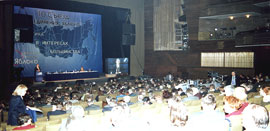


Chair of Udmurtia Yabloko Iya Boronina demands disclosure of Ministry of Digital Development and Roskomnadzor acts that permitted the slowing down of Telegram
Press Release, 12.02.2026

Photo: Iya Boronina / Photo by the Press Service of the State Council of the Republic of Udmurtia
The leader of Yabloko in Udmurtia, Iya Boronina, sent an official request to the Ministry of Digital Development of Russia demanding to provide legal justification for the reasons for slowing down the Telegram messenger. The acts of the Ministry of Digital Development and Roskomnadzor (the Federal Supervision Agency for Information Technologies and Communications) that legally permitted the slowing down must be made public. In addition, Iya Boronina proposed introducing free Internet access points on the premises of kindergartens, schools, colleges and universities – to enable students to communicate with family members in the event of emergencies.
The appeal to the Ministry of Digital Development, Communications and Mass Media of the Russian Federation was sent in response to complaints from residents of the Republic of Udmurtia. Communications were slowed down, but no official comments followed from departments and authorised bodies. At the same time, the Telegram messenger remains virtually the only means of communication on the Internet that has not yet been officially banned on the territory of the Russian Federation.
“In my appeal I am asking for an explanation of the reasons for the slowing down of the Telegram messenger on the territory of the Russian Federation with legal justification (acts of the Ministry of Digital Development of Russia and Roskomnadzor); for an indication of the period for which the decision has been taken by the authorised body (if such a decision has been taken); and for an indication of whether a complete ban on the Telegram messenger on the territory of the Russian Federation is being planned,” Iya Boronina explained.
In the same letter, the leader of Udmurtia Yabloko proposed that the department introduce free Internet access points on the premises of educational organisations – preschool institutions, general education institutions, vocational education institutions, and higher education institutions. This could ensure communication between students and family members in the event of emergencies.
It should be also noted that, on 11 February, Yabloko Chairman Nikolai Rybakov demanded an end to restrictions on citizens’ lawful rights to use means of communication. A day before the statement, Roskomnadzor had begun decisively blocking Telegram, claiming that the messenger “was not complying with Russian legislation”, and that restrictions were allegedly needed to protect citizens from fraud and to create conditions for suppressing extremism and terrorism.
“In the vast majority of cases, the fraudsters allegedly cannot be found, and we understand why: law enforcement is focused on searching for extremists” on social media and “monitoring” the posts of opposition politicians, including the posts from many years ago. We believe that, under demagogic pretexts that have no basis in reality, Russian citizens are being deprived of yet another opportunity to freely, accessibly, and uncensoredly communicate with their families and friends, and receive information about events in the country and the world. They are also being forced to switch to the “state-owned messenger” MAX, which is controlled by security forces and, as many rightly believe, does not ensure the privacy of correspondence guaranteed by the Constitution,” the statement by the Yabloko Chairman runs.
On 11 February Yabloko held an action in Moscow calling for an end to the blocking and slowing down of Telegram. Russia does not need “digital barriers”, we need a modern, open society capable of dialogue, the participants declared.
Posted: February 12th, 2026 under Freedom of Speech, Governance, Human Rights, Yabloko's Regional Branches, Без рубрики.