


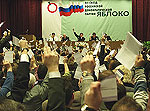




Yabloko hosted Alexander Gnezdilov’s lectre “Not Only the West: Democracy Japanese-Style”
Press Release, 21.10.2025

In mid-October Yabloko hosted a lecture “Not Only the West: Democracy Japanese-Style” by Alexander Gnezdilov, member of Yabloko’s Federal Political Committee, editor-in-chief of Smart Power Journal and author of the Telegram channel “Gnezdilov. Against the Current”. The lecture was organised by the Yabloko party’s Analytical Centre
The end of the Second World War, the Tokyo trial of war criminals and the adoption of the so-called Peace Constitution of 1947 during the American occupation meant that Japan, renouncing militarism, embarked on the path of liberal parliamentary democracy. In this capacity, the country became one of the world’s largest economies and a full member of the G7.
At the same time, the authenticity of Japanese democracy has been questioned more than once. This was primarily connected with the long-term dominance in Japanese politics of the Liberal Democratic Party (LDP): in 70 years since 1955, there have been only two brief periods (1993-1996 and 2009-2012) when LDP representatives did not head the Japanese government.
During the public lecture, Alexander Gnezdilov together with participants answered the following the questions:
To what extent is Japan’s political system truly competitive and democratic?
What historical legacy were Japanese democrats and liberals able to draw upon?
What is changing in Japanese politics at present, when the LDP lost its majority in the lower house in 2024 and in the upper house of parliament in 2025?
What does the resignation of Shigeru Ishiba from the post of LDP leader and Prime Minister of Japan in October 2025 mean for the country’s course, and who is replacing him?
What forces compete with the LDP and how do global trends influence Japanese politics, including the growing influence of dictatorships and the rise of right-wing and far-right populism in democratic countries?
The lecture provoked lively interest and wide-ranging discussion amongst the audience. Some of them agreed to publish their impressions.
Ivan Bolshakov, head of the Yabloko Analytical Centre noted, “We conceived an entire cycle of lectures about Far Eastern democracies, and decided to start with Japan. Why Japan specifically? Firstly, because Japanese politics displays parallels with competitive democratic systems in Europe, where party coalitions and parliament rule the roost. Secondly, there are parallels with Russia. As is well known, Japan has a dominant party system, where the Liberal Democratic Party has been at the head of the country practically continuously for many years, with the exception of two short periods. Thirdly, this system has existed since 1955, and this year marks its 70th anniversary. The other day, internal party elections concluded in the LDP: for the first time, a woman was elected leader of this party. But it’s not all that simple. The LDP’s traditional partner, the Komeito party, this time refused to support Sanae Takaichi.
Russia has many orientalists and quite a few Japan specialists, but those who deal specifically with Japanese electoral politics are not so numerous. Alexander Gnezdilov has been studying Japanese politics for many years. He is one of the few in our country who can cover this topic in detail and professionally.”
Posted: October 22nd, 2025 under Conferences and Seminars.