


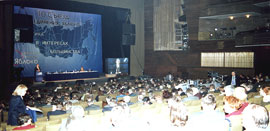


“We have extensive experience of surviving in sulphuric acid”: interview with Yabloko party Chairman Nikolai Rybakov
Novaya Gazeta. Baltiya, 11.06.2026

Photo by the Yabloko Press Service
Forty-seven-year-old human rights defender and environmentalist Nikolai Rybakov is the fourth chairman of the Yabloko party. He joined the party in 1995 and rose from ordinary member to the head of Russia’s largest and still-unbanned anti-war organisation. Rybakov became party chairman in 2019, meaning that his tenure has coincided with mass political repression, the beginning of the full-scale war, and the transformation of Putinism into its totalitarian form.
Novaya Gazeta. Baltiya spoke with Rybakov about the 2026 State Duma campaign, the persecution of party members, and whether there is any point in taking part in elections that do not determine state policy — as well as about the young people joining the party, human rights work, and what protest voting might look like at these elections.
— A direct question: what are the electoral prospects for a party that has neither administrative resources nor an alliance with the authorities, in Russia in 2026?
— You could ask the same question about life in Russia in general: what kind of life prospects do any of us have who are not in power? We have no other choice. But we can change the circumstances in which we live.
It is hard to say right now whether those circumstances can be changed. That is precisely why many people have concluded that it is impossible to influence what is happening, and are not even doing what is within their power. I proceed from a different premise: in this life, one must do what one ought to do. Given that we are united as a party, I do what our entire collective ought to be doing. Will it influence the course of events? That depends largely on whether millions and dozens of millions of people support us. If that happens, the likelihood of change for the better will increase sharply.
Yabloko has consistently advocated the peaceful resolution of all possible conflicts for more than 30 years, and has always opposed wars.
If people say that they want politicians who preserve human lives, the situation will change. Then we will be able to say that our work was not in vain.
I should note that Yabloko has never operated under conditions of maximum favour. We have always faced repression against our comrades. Party members have been killed for their convictions — one need only recall Yuri Shchekochikhin and Larisa Yudina [killed for their work]. We have, regrettably, extensive experience of surviving in sulphuric acid.
— We will come back to the current persecution and repression separately. But let us first discuss the campaign ahead of the September elections: what appeals and slogans is Yabloko putting to voters?
— Our slogan has not changed since 24 February 2022. Before that, every election campaign ran under a new name. Now we have a single slogan for any election, whether at municipal level or for the State Duma: “For Peace and Freedom”. What that means in practice: the immediate signing of a ceasefire agreement.
This year we have added a second part, because we are thinking about what will come after [the end of the war]: “For a Life Without Fear”. We want people to build their future in Russia — not to leave Russia, not to be afraid to live here, not to be afraid for their children and parents. And not to be afraid of being spied on, censored, fined, and imprisoned. Freedom and a life without fear in one’s own country — that is what we are taking into all forthcoming elections: State Duma elections, regional elections, and local elections.
— Even so, how do you assess the party’s prospects at these elections, and what results would you consider most successful?
— Alex, we do not view the current elections as a mechanism for forming bodies of power. Regrettably, that is not what they are.
For us, they are an opportunity to communicate our position on the most important issue. For the public, they are perhaps the only currently lawful and relatively safe way to express disagreement with the authorities’ policy on that issue. We know of no other way for tens of millions of people to do this.
That is why we do not speak of any specific result: it could be anything. If our campaign helps stop the killing of people, we will have succeeded. If an atmosphere emerges in society such that in September everyone goes out and votes for Yabloko’s list of candidates — the list of peace — that mood will influence the decisions of the authorities.
One day there will again be elections at which state policy is genuinely formed. That is not the case now. Voting today is, to a certain degree, a civic act — a way to come forward and express one’s position.
— On the subject of your list of candidates: the authorities are removing many Yabloko candidates from elections through fines for reposts, images, and other mechanisms of their own devising. How do you plan to keep your list intact?
— Here the effect of a football team applies. There are many people who can play football. If the main squad has been suspended, but there is a reserve squad, a youth team, and in general a great many people who can take to the field.
You are right that the authorities’ strategy — or rather tactics — is to remove well-known party members from elections by different means. Some are sent to prison, some are placed on the foreign agents list — I would call it the “insult list” — and some are fined minimal sums that formally disqualify them from standing in elections.
On the whole, though, the number of people they have removed is not that large, and they will not succeed in completely derailing our formation of a party list. The next squad will take to the field. We are also continuing to contest the fines. On my own fine (Rybakov was fined in December 2025 for displaying a photograph of Alexei Navalny on social media — Ed.), we are awaiting a Supreme Court ruling by 26 June. We are doing everything to have it overturned. But whatever happens next — we will all be campaigning for our list.
— Surely you understand that if the authorities set themselves that task, they could remove the next squad by the same mechanisms…
— There are millions of people in Russia who support our position. You cannot fine millions of people.
— Not everyone is ready to enter public politics.
— In the end, we do not need a million, we need three hundred people: three hundred Spartans. That is precisely the size of the list we plan to put forward. It is entirely achievable.
But something else matters more. The main result of the campaign is not mandates but the opportunity for people to speak out, and the shift in public mood. For years, both the authorities themselves and part of the opposition convinced people that elections decided nothing. Now we find ourselves working against that machine: proving that voting remains a way to express one’s position.
Tzar Ivan the Terrible did not succeed in destroying free-thinking people in this country. Nicholas I did not succeed. Stalin did not succeed. The current authorities will not succeed either. Yes, repression affects the lives of specific individuals. When our colleague from Khakassia, journalist Mikhail Afanasyev, was sent to a penal colony for five and a half years, he was torn from his children for half of their childhood. That will leave a mark on their lives. But it cannot bring about a Russia in which there are no longer people willing to say: nothing matters more than human life, nothing matters more than the rights and freedoms of people, and the state must serve those ends rather than itself. That cannot be eradicated.
— I entirely agree with you on that point, but I was asking more about political manoeuvres. Would you be prepared, for instance, as a last resort, to call for votes for candidates from other parties?
— That is impossible. Russia now effectively has a two-party system. There is one large party of Vladimir Putin, with different factions within it — communists, Zhirinovsky’s nationalists, populists, A Just Russia, New People, pseudo-Greens, and Stalinists: all of these are Putin’s parties. And there is Yabloko. That is the whole system. Calling for votes for one of Putin’s parties — no, we cannot do that.
— Some politicians have nonetheless used that tactic…
— It is a catastrophic policy, and I hope this error is now apparent to everyone. You cannot call on people to vote for members of cannibalistic parties simply because they have not yet tried human flesh. They end up in the State Duma and then compete with one another to see who can most loudly support Vladimir Putin’s policies.
— The alternative is intense pressure, as in your case: criminal proceedings against your regional leaders, fines against candidates, and other ways of making life harder.
— That could be described as a form of dialogue with the authorities. We say that our position is for peace, and the authorities reply: very well, here is another [court] case for you. And we understand that the more people in the country support us, the more intense that pressure will become.
— What is the latest chapter in this rather unpleasant dialogue?
— It could be unfolding right now, as we speak, and we simply do not yet know about it. But among important recent developments: on the evening of 25 May, the head of our faction in the Petrozavodsk City Council was detained — a member of the Federal Bureau of the party, a well-known environmentalist, and my namesake, Dmitry Rybakov. He was held at the police station throughout the night so that he could be convicted in the morning under the article on the dissemination of extremist materials — materials which are, of course, not extremist in any way. Standard tactics.
As for the overall picture: virtually all Yabloko deputies in regional parliaments have received fines carrying a ban on standing for election. Twelve party members have been given foreign agent status, including my Deputy Chairs Boris Vishnevsky, Lev Shlosberg, and Vladimir Dorokhov, as well as Nobel Prize laureate Dmitry Muratov and human rights defender Svetlana Gannushkina.
Three members of the federal leadership of our party are currently on trial: Maxim Kruglov, Lev Shlosberg, and Konstantin Smirnov. Three have been convicted: Mikhail Afanasyev in Khakassia, Vasily Neustroyev in St. Petersburg, and Vladimir Yefimov in Kamchatka. In total we have had more than forty detentions and administrative proceedings. The total sum of fines amounts to 8.5 million roubles.
Before that there was a major case in Irkutsk: our regional branch leader Grigory Gribenko, who was to have stood as a candidate in the Duma elections, was arrested twice. In December [2025] he organised a rally in defence of Lake Baikal, which I attended. A rally against Internet blockades was planned for January, but the authorities decided they did not need that many rallies and explained to Grigory that they would be cancelling not only the rally but Grigory himself.
— Do you still have any mechanisms at all for communicating with voters?
— We use every opportunity available. Imagine you need to cross a raging ocean, with waves and sharks all around. We swim as best we can — sometimes front crawl, sometimes breaststroke, sometimes doggy-paddle; if a log turns up, we cling to the log. It there is airtime — we use the airtime; if there are social networks — we use social networks; if there is an opportunity to meet people in person — we meet them. Everything lawful that can be done, we will do; we will not give anything up.
Even during the relatively calm 2000s, we were forbidden from distributing leaflets and putting up advertising — to say nothing of now. But there is one particular feature of the current situation.
We are now clearly associated with the anti-war agenda. If a person in Russia in 2026 understands that the country must take a different path, they will see Yabloko on the ballot paper and vote for it — regardless of whether our campaign materials have reached them or not.
— Can you give an approximate figure for your supporters?
— I am convinced that the defining issue at these elections is peace. The question to measure, therefore, is not party ratings but how many people are in favour of stopping the killing. According to surveys, that is around 60% of Russians. Which means that Yabloko is with that majority. All the other parties are dividing up the votes of the minority between them.
As for the sociology: even the surveys published by VTsIOM record qualitative changes: Yabloko’s electorate is getting younger, and young people are voting for the party in ever greater numbers. But I would not want to speak about quantitative results. In conditions of a fully cleared information landscape, where it is impossible to make yourself heard normally, opinion polls do not reflect the real picture.
— Let us talk about young people, since it is among them that support for peace and change is strongest. How does work with young supporters function, and how strong is Youth Yabloko?
— We do not divide party members into young people and everyone else — everyone works together. But since 24 February 2022, and especially over the past two years, the changes have been noticeable. First, the number of people wishing to join the party has grown. Second, the share of young people among them has risen sharply.
Previously, it was mainly middle-aged people who came to us. Now people join the party who have just turned 18, and even those who are 14 to 16. And yet they were born after Yabloko was last in the State Duma [in 2003]. They carry no weight of party history, but they see our position today and understand that it reflects their interests. And those interests are simple: to live in Russia, not to leave it, not to die, build families, businesses, and develop creatively.
This is not something only we notice, the authorities notice it too. Hence [the authorities come up with] projects such as the New People party: an attempt to create the illusion of a party for the future, for freedom, for peace. But then they enter the State Duma and vote exactly as United Russia does, and sometimes even more cynically. Young people who live online, fortunately, can read that. I see it in the videos that young people film themselves and send to me: they understand that there are parties that deceive, and parties that are genuinely for peace and freedom.
— In Yekaterinburg, a group of young Yabloko supporters dissolved itself under pressure. What happened there?
— We are a liberal party, and our rules for internal life are not always strict. In Yekaterinburg there was a group of young people who were not party members but called themselves Youth Yabloko. We are grateful to them as supporters. But repression takes its toll. One cannot blame people for becoming frightened. Regrettably, that is a natural reaction, there is nothing shameful in it. The party in Yekaterinburg and in the Sverdlovsk Region continues to function, and we are preparing for the regional elections in September. This has had no effect on our positions.
— So the security services were putting pressure on them?
— Yes. There had already been a second round of searches within the year. Armed security officers came to the office. This is absolutely impermissible, and we made our protest against what was happening clearly known.
— There is a view that the Kremlin wants to liquidate the party altogether. Could the authorities bring themselves to dissolve Yabloko?
— That is not a question that features on my working agenda. If I were to proceed from that premise, how would I structure my work and my own life? We are doing everything to continue operating in whatever organisational and legal form is available. And we will not change our position.
— Let us then speculate and imagine that Yabloko has returned to the State Duma. What would your first legislative proposals be?
— It will return — there is no need to imagine it. The first package is entirely unambiguous: the repeal of all repressive laws. Beginning with the “scoundrels’ law” (the “Dima Yakovlev Law” banning the adoption of Russian children by American citizens — Ed.), one of the most demonstratively anti-human laws on the books. Then the foreign agents laws, the laws on undesirable organisations, and any other discriminatory legislation. People must have freedom of expression, freedom of assembly, freedom to build the country as they see fit.
I would add on my own behalf: all environmental legislation passed since the year 2000 must be repealed. Since then there has been continuous degradation of environmental law. It is precisely that degradation which made possible, for example, the felling of forests in the Baikal ecological zone. In the early 2000s, our environmental law was ahead of European standards. Now we have lost all of that and handed nature over to those who destroy it.
— Who will form Yabloko’s dream team and be the face of the party at the elections?
— I suggest we speak about that after our pre-election congress. If we give names now, we are effectively handing the authorities a list of people they have not yet managed to fine. Once a candidate is formally nominated, fining them is no longer permitted — so let us talk then.
— Yabloko seems to be a rare example of a Russian party in which a genuine change of leadership has taken place. Has Yavlinsky, around whom the party was once built, stepped back from an active role?
— Grigory Yavlinsky has not gone anywhere. That is precisely what is valuable: all former chairmen continue to work actively. Grigory Yavlinsky heads the Federal Political Committee; Emilia Slabunova and Sergei Mitrokhin are members of it. Slabunova, incidentally, has also been fined [which prevents her from standing in the coming elections] — she leads our faction in the Legislative Assembly of Karelia.
The example we want to set for society: a change of leadership does not mean that a departing chairman should be sidelined and excluded [from party life]. They continue to work as part of a single team.
— Alongside public politics, Yabloko has recently taken on a human rights function. In particular, you demanded that the head of the Federal Penitentiary Service conduct an internal inquiry when political prisoner Azat Miftakhov alleged that he had been tortured in a penal colony. Tell us a little about that.
— This is very important, both for us and for our country. If one looks at the past hundred-odd years of Russian history, one sees a process of dehumanisation and the cultivation of contempt for the value of human life. The First World War, the Russian Revolution, the Red Terror, the Civil War, collectivisation and famine, the Great Terror, the Second World War, the Siege of Leningrad as a distinct component of it… And then Afghanistan, two Chechen wars, and the situation we have arrived at now.
Throughout all of that time, the authorities did everything to ensure that the value of human life was zero or even negative. To ensure that a person as an individual counted for nothing in the face of the mythical interests of the state, its mythical greatness — a greatness defined solely through the capacity to wage war. If the greatness of the state were measured by achievements in science, education, life expectancy, and quality of life, there would be different priorities and different decisions. But greatness is deliberately cultivated through military action and through the devaluation of human life: you are a cog, you are a wood shaving that will fly off and leave no trace.
Changing state policy as a whole is impossible without defending every specific individual, regardless of their political views. I do not know what views Azat Miftakhov holds, and at this moment that does not interest me. No person may be subjected to violence, torture, or actions that degrade human dignity.
When amendments to the Constitution were being introduced [in 2020], Yabloko was the only party to put forward proposals as an alternative to Vladimir Putin’s. One of our amendments was a constitutional prohibition on torture and criminal prosecution for it. International practices show that if a problem cannot be resolved at the level of ordinary legislation, it must be enshrined in the Constitution as an inviolable norm. Regrettably, subsequent events have demonstrated the relevance of that proposal.
That is why, in addition to making our own formal requests, we call on our supporters to send theirs as well. One Yabloko supporter wrote to me just before this conversation to say that she too had been sending requests in connection with the Miftakhov case.
And letters must also be written to political prisoners. Actions of writing letters to political prisoners are held in party offices across the country. It matters that a person knows they are remembered and that they are not alone. I urge everyone who has read this far in the interview to visit the Yabloko website: there are detailed instructions there on how to write such letters. And if you know someone who is being unjustly persecuted, write to them.
Posted: June 15th, 2026 under Elections, Environmental Policies, Foreign policy, Freedom of Assembly, Freedom of Speech, Governance, History, Human Rights, Judiciary, Political Parties, Protection of Environment, Regional and Local Elections, Regional and Local Elections 2026, Russia-Eu relations, Russia-Ukraine relations, Russia-US Relations, State Duma Elections, State Duma Elections 2026, YABLOKO Against the Parties of Power, YABLOKO and Other Political Parties, Yabloko's Regional Branches, Без рубрики.