




Sverdlovsk Region Court removes Yabloko’s list from Legislative Assembly elections on LDPR claim. Decision to be appealed
Press Release, 28.08.2026

Photo: On the left, Yabloko representatives Yaroslav Shcherbakov (standing) and Konstantin Kiselyov; on the right, a judge of the Sverdlovsk Region Court / Photo by the Yabloko Press Service
On 28 August, the Sverdlovsk Region Court upheld LDPR’s claim and cancelled the registration of Yabloko’s candidate list for the regional Legislative Assembly elections. The ruling has not entered into legal force and will be appealed by the party.
Until the ruling enters into force, Yabloko’s list remains on the ballot. The ruling also does not affect the party’s candidates taking part in the elections in single-mandate constituencies.
Yabloko’s interests were represented by Leonid Buyny, a candidate for the Legislative Assembly, and Yaroslav Shcherbakov, lawyer, member of the Federal Bureau, Chairman of Chelyabinsk Yabloko and leader of the party’s list for the State Duma elections. Also taking part in the hearing was Konstantin Kiselyov, leader of Yabloko’s list for the Legislative Assembly elections and a deputy of the Yekaterinburg City Duma.
The electoral commission supported the claim, even though it had had no objections to Yabloko at the time of registration.
At the start of the hearing, Yabloko’s representatives asked for the case to be adjourned, since LDPR had not provided the party with the appendices to its claim. The court refused the motion.
Yabloko also asked for the case to be transferred to the Moscow City Court, with the party’s representatives pointing out that the administrative defendant was the federal party, not its Sverdlovsk regional branch. The court dismissed this motion as well.
LDPR sought to overturn the regional electoral commission’s ruling of 6 August registering Yabloko’s list. Among its grounds, the claimant cited the use of information resources with restricted access, alleged violations of intellectual property law, and exceeding the statutory limit on election fund spending.
LDPR’s representatives largely repeated the arguments previously used when the Supreme Court considered the case concerning the removal of Yabloko’s federal list from the State Duma elections. These concerned, in particular, posts by the party and its candidates on social networks with restricted access, an interview with Grigory Yavlinsky, and the use of song excerpts and elements of bank branding.

Photo: Yaroslav Shcherbakov shows a judge of the court an excerpt from an interview with Lev Oshanin / Photo by the Yabloko Press Service
The claimant, in effect, proposed extending the circumstances of the federal election campaign to the elections in the Sverdlovsk Region. LDPR’s representative also stated that Yabloko’s campaigning on social media had received around 180 million views and had allegedly placed other parties at an unfair disadvantage.
During the hearing, Shcherbakov asked LDPR’s representative what legal grounds would allow the list’s registration to be cancelled. Instead of answering on the merits, the claimant’s representative stated that he was a professional lawyer and asked Shcherbakov whether he was one too.
Yabloko: the federal and regional campaigns cannot be conflated
The party’s position on the merits of the claim was set out by Yaroslav Shcherbakov. He stressed that Yabloko’s federal campaign and its campaign for the Sverdlovsk Region Legislative Assembly elections had to be considered separately, and that the circumstances of one campaign could not automatically become grounds for cancelling registration in another election.
According to Shcherbakov, some of the circumstances cited by LDPR did not, in fact, fall within the statutory grounds for cancelling a list’s registration at all. Nor, he said, could the actions of citizens who independently supported Yabloko and spread information about the party be attributed to the party itself.
Shcherbakov also rejected the claim that Grigory Yavlinsky’s interview constituted election campaigning. Yabloko’s representatives cited the Constitutional Court’s position that the dissemination of information about a political party by third parties cannot arbitrarily be classed as campaigning.

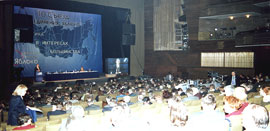
Photo: Not all of Yabloko’s supporters who came to the hearing could fit into the courtroom — a video link was set up for them in an adjoining room / Photo by the court’s press service
Leonid Buyny, for his part, presented the court with screenshots of LDPR’s own campaigning on social networks with restricted access. In his address, he called on the court to “maintain a careful regard for the law”.
Court watches Lev Oshanin interview that could not be shown in the Supreme Court
One of LDPR’s complaints concerned an alleged copyright violation in Yabloko’s use of the song “Let There Always Be Sunshine”.
Something happened in the Sverdlovsk Region Court that had not happened when the case concerning the party’s federal list was heard in the Supreme Court: the judge allowed the defence to show a video recording of an interview with the poet Lev Oshanin, an heir of one of the song’s author, directly.
Shcherbakov played an excerpt of the recording from a laptop, in which Oshanin explains that the famous lines “Let there always be sunshine” were not written by him, but by an unknown boy in 1928. An excerpt of the song itself was also played in the courtroom.
In addition, Gleb Oshanin and Mikhail Ostrovsky, heirs of the song’s authors, formally gave Yabloko permission to use the work in its election campaigning.

Photo by the court’s press service
In his address, Konstantin Kiselyov also spoke of what he considered the absurdity of the complaints relating to the use of intellectual property. As an example, he pointed out that Russian banks advertise “Mir” (Ed. “mir” means “peace” in Russian) payment cards: following the claimant’s logic, Kiselyov argued, this could be considered campaigning in support of Yabloko, which stands for peace (“mir”) and freedom.
Kiselyov also showed his tattoos reading “Towards Perpetual Peace” and “It is forbidden to forbid”.
Prosecutor and electoral commission back removal of the list
A representative of the Sverdlovsk Region Electoral Commission supported LDPR’s claim. In court, however, she acknowledged that the Commission had had no objections to Yabloko’s participation in the elections at the nomination and registration stage. The Commission linked its current position to the Supreme Court’s ruling of 10 August in the case concerning the party’s federal list.
In his submission, the prosecutor also supported LDPR’s demand that the list’s registration be cancelled.
In closing arguments, Yaroslav Shcherbakov said: “The citizens of the Russian Federation are tired of what is happening; they want peace and freedom.”
“In our country, it is forbidden to fight for the abolition of prohibitions,” said Konstantin Kiselyov.
After closing arguments, the court withdrew to deliberate, then announced that it was upholding LDPR’s claim.

Photo by the court’s press service
“Peace, freedom, love”
Before the ruling was announced, Konstantin Kiselyov said that he had not heard any legal arguments during the proceedings capable of refuting the party’s position.
“I am impressed by what my colleagues — the administrative defendants — have done: absolutely everything was refuted thoroughly, point by point, with supporting materials provided.
I don’t know what the ruling will be. I can guess what it will be. But I do want to note that the proceedings were conducted in a fairly civil atmosphere.
I am grateful to the people who came to support us. I am moved to tears. The future doesn’t belong to the prosecutor, or to me. The future is right here, standing in this room. And we can see quite clearly what it is telling us: peace, freedom, love. Those are the slogans to go into the elections with. And it is for them, for this future, that all of this is being done,” Kiselyov said.
After the ruling was announced, Yaroslav Shcherbakov said the party would certainly appeal against it.
“The ruling was expected, but there is no need to be downhearted. We are stronger than ever — and today we received confirmation of that.
The ruling has not entered into legal force and will certainly be appealed. The list remains on the ballot.
The court’s ruling has no bearing whatsoever on our candidates taking part in single-mandate constituencies in the elections to the Sverdlovsk Region Legislative Assembly, or on Yabloko’s candidates in single-mandate constituencies in the State Duma elections.
Residents of Sverdlovsk Region and of our Urals regions can support candidates who stand for peace and freedom in their own constituencies. People of the Urals, come out and vote — there is a choice.
And we will keep fighting to ensure that Yabloko’s list stays in the elections, and that the people of the Sverdlovsk Region have a choice in the Legislative Assembly elections too,” Shcherbakov said.
Eighteen Yabloko candidates continue to take part in the elections to the Sverdlovsk Region Legislative Assembly in single-mandate constituencies. A further six of the party’s candidates are standing in the Sverdlovsk Region in single-mandate constituencies for the State Duma elections.
The Sverdlovsk Region has become the sixth region where attempts are being made to prevent Yabloko’s list from taking part in the regional parliamentary elections. The party’s lists have previously been removed from the elections in St. Petersburg, the Leningrad Region, Karelia and the Pskov Region. In the Kaliningrad Region, Communists of Russia have filed a claim seeking to cancel the registration of Yabloko’s list, with the hearing scheduled for 28 August.
The Sverdlovsk Region Court’s ruling has not entered into legal force. Yabloko will appeal against it.
Posted: August 28th, 2026 under Elections, Freedom of Speech, Governance, Human Rights, Judiciary, Regional and Local Elections, Regional and Local Elections 2026, State Duma Elections, State Duma Elections 2026, Yabloko's Regional Branches, Без рубрики.