


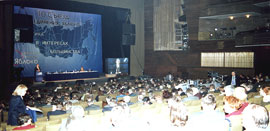


Nikolai Rybakov’s speech before the Appeals Panel of the Supreme Court of the Russian Federation
Appeal against the removal of Yabloko’s list of candidates from the parliamentary elections, 17.08.2026

Photo by the Yabloko Press Service
Honourable Court,
Esteemed participants in these proceedings,
Before the hearing began, at least 35 people who came for today’s hearing — despite there being free seats in the courtroom, and despite having broken no rules — were detained and taken to police stations. Among them is Viktor Balabanov, a candidate for the State Duma, whom we had invited to today’s hearing so that he could act as a witness.
Moreover, over the past two days, law enforcement officers in Moscow have been visiting people who attended a lawful, open [Supreme Court] court hearing [on the removal of Yabloko from the parliamentary election] a week ago — journalists and State Duma candidates from Yabloko — and issuing all of them with formal warnings against committing offences. I cannot call this anything other than intimidation. I believe that everyone must be released today.
Now, turning to the decision the Supreme Court will hand down today.
Part I. On the degradation of state institutions and legal nihilism
Today, the Supreme Court of Russia will hand down a decision that goes far beyond the electoral process and the election of merely another convocation of the State Duma.
This is about a fundamental question for our country: whether Russia has state institutions capable of remaining within the framework of the law even in times of crisis and hardship — or whether the rule of law will be finally and irrevocably destroyed to serve short-term interests. Today this concerns Yabloko’s participation in the elections, but this decision will extend to all participants in the elections and will destroy elections in Russia.
By the ruling of the court of first instance on 10 August, millions of Russian citizens were deprived of their constitutional right to choose. Yabloko’s federal list was removed from the State Duma elections. And this was done with such ease, with such blatant disregard for the foundations of Russian law, that anyone concerned about our country’s future cannot help but feel deep alarm for the very stability of our statehood.
In pursuit of their own narrow self-interests, and out of fear of honest, open, public debate, our opponents are destroying the foundations of Russia’s legal system. They are undermining trust in fundamental institutions, including the Central Electoral Commission and the highest judicial authority.
To what end is all this? So that no political force offering society an alternative, peaceful, and constructive programme remains on the ballot? So that Yabloko, by any means necessary, in defiance of logic and common sense, can be eliminated as a legitimate participant in the elections? But in destroying the legal order in their fight against us, they are destroying the Russian state itself!
Throughout its history — more than thirty years of legal political struggle — Yabloko has stood, stands, and will continue to stand for strong, stable, independent state institutions in Russia. We have always defended, and continue to defend, the foundations of the constitutional order. We are deeply convinced: a state is not made strong by bans, repression, artificial barriers, or manipulation of legal texts. A state is made strong by citizens’ trust in its laws and its institutions, including its courts. What happened in the court of first instance completely tramples and destroys that trust.
By its very nature, an election is an instrument for revealing the genuine will of the people. It is a peaceful, civilised means of resolving social conflicts. When you forcibly break this instrument, you deprive society of a peaceful means of seeking compromise and consensus. You drive social discontent underground, creating enormous risks for the country’s future stability. We, the Yabloko party, are defending the state’s stability by demanding compliance with the law. Those who are trying to remove us from the elections are the ones undermining that stability.
Part II. The political and legal absurdity of the “foreign financing” allegations
Honourable Court,
I propose we turn to the strict political and legal substance of the so-called “facts” on which the contested decision was based. Let us start with the first and most sensational point: the allegation of mythical “foreign financing”.
To any professional with even a passing understanding of how the strictly controlled, fully transparent financial system of Russian political parties operates — both between elections and during an election campaign — this allegation sounds like sheer legal and economic fantasy. Our legislation regulates, down to the smallest detail, the movement of every rouble in a political party’s budget. Every year, we undergo a full independent external financial audit of all our accounts and the work of the party and its regional branches; all financial reports are published on the Central Electoral Commission’s website.
If even a single rouble of genuinely foreign origin had entered Yabloko’s election fund or the party’s main election account, this would have become known instantly — through automatic digital monitoring — to the Central Electoral Commission, the Ministry of Justice, and Sberbank, where the party’s main and special election accounts are held. Our financial system is not merely transparent — it is under the state’s microscope. By law, the Central Electoral Commission and the authorised bank are required to immediately block and return any transfer that breaches the established requirements.
Moreover, current legislation (Article 35, Clause 5, of Federal Law No. 95-FZ “On Political Parties”) places a direct obligation on electoral commissions: to notify a political party immediately of any identified financing violations. Why is this required? So that the party can take timely action, return any erroneous or unlawful payment, and continue its campaign within the framework of the law. But we received no notifications, no warnings, and no complaints whatsoever from the Central Electoral Commission or the Ministry of Justice either earlier, at the list-nomination stage, or at the stage of its official registration! All procedures were completed strictly in accordance with the law; the documents were checked and certified.
Why did this happen? Because there were no foreign transfers at all.
And what do we see instead of these lawful, transparent, state-established procedures? Information from a vague, classified Rosfinmonitoring memo is inserted into the ruling of the court of first instance. What does it say? It claims that a certain citizen of the Russian Federation transferred Russian roubles from his account to another Russian citizen. And this document is inflated to the scale of a threat to the state, and entitled: “Memo on Foreign Sources of Financing”! And the total sum involved is 16,900 roubles — for the entire federal party.
Honourable Court, this is a pure travesty of justice. There is not a single proven fact in the case file that this 16,900 roubles has any connection whatsoever to foreign sources — let alone [the allegation] that Yabloko or its authorised representatives knew about these transfers between certain third parties, approved them, or used them in the party’s activities.
The court of first instance completely and demonstratively ignored Article 62(1) of the Administrative Court Procedure Code of the RF. Under this provision, the burden of proof falls on the party alleging a violation — that is, on the administrative claimant. Instead, the court shifted onto us the burden of proving a negative — a fact that did not exist in the first place. Yabloko was required to prove something that simply did not exist. We have never received foreign financing in any form. A representative of the prosecution asked me at the 10 August hearing whether we had returned any funds we had received, to which I replied, “No, because we never received them!” The prosecution representative said, “There you go, you have confirmed you did not return it,” neglecting to mention that you cannot return something you never received in the first place.
At the same time, the material from this “classified” memo was included by the court of first instance in its ruling, even though the text of the ruling itself gives it no legal assessment whatsoever. I believe this was done solely in an attempt to discredit Yabloko. And what do we see? Immediately after the hearing, state news agencies ran headlines claiming “foreign financing discovered”. In other words, a direct lie, born in the courtroom of the Supreme Court.
In effect, state agencies and the judicial authority of the first instance were turned into a crude instrument for discrediting our party. I believe that today the erroneous decision of the court of first instance will be corrected.
Part III. Manipulation involving internet publications
Let us turn to the second part of the allegations, which looks even more damaging to the legal system. We are accused on the basis of so-called materials assessing the commercial value of internet publications, prepared by the self-regulatory organisation “Association of Bloggers and Agencies”. My colleagues will demonstrate, in detail and with legal facts in hand, the procedural and substantive worthlessness of this anonymous, unsigned memo, which is neither a forensic expert examination nor a valuation report. It contains no methodology, and was drawn up by unknown individuals bearing no criminal liability for false conclusions. Yet the court of first instance, for some reason, accepted it as absolute, irrefutable proof — proof, moreover, of something the memo does not even state. Yesterday the “Association of Bloggers and Agencies” stated publicly that the memo was an expert-analytical assessment estimating the potential market value of placements. The memo did not establish the fact of any payment, nor the existence of any contractual or other relationship whatsoever.
I would like to dwell on the profound political danger of this precedent. What was included in this artificially assembled set of 212 publications, which the court has attributed to us as “Party expenditure outside the election fund”?
The first type of publication: news reports by officially registered news agencies about decisions of electoral commissions and courts. In other words, when the press honestly informs citizens that Yabloko is being removed from regional elections somewhere — in St. Petersburg or Karelia — the court of first instance seriously believes that we secretly hired these agencies ourselves and paid them for these publications! This is an absurdity that destroys freedom of the press.
The second type: expressions of personal opinion and civic solidarity from independent journalists, bloggers, and ordinary social media users, many of whom Yabloko has no connection to whatsoever — and, by law, cannot have. The law directly guarantees citizens the right to freedom of speech, yet the court decided that the party should be held responsible for citizens’ words. More than that — should pay for them. It is worth noting that some of these publications belong to party members and members of regional branch leadership bodies. I can only assume the technical staff member who compiled this set did not think to check exactly who was being included. According to this memo, some party members are paying other party members to write about themselves online. And this absurdity has been written into the court’s ruling.
The third category: publications that do not mention Yabloko even once. They discuss the arrests of unrelated individuals, the blocking of foreign platforms, everyday news — yet the authors of the memo deemed this “covert support”, and the court of first instance copied this straight into its ruling.
The court of first instance has created a precedent of colossal destructive power. It has, in effect, legalised selective, discriminatory law enforcement. From now on, any public, independent statement by a citizen on social media, any expression of sympathy for a political party, can be artificially valued at millions of roubles and used by the authorities as a legal pretext for destroying a specific political rival. This is not merely a blow against Yabloko — it is a total, suffocating ban on informing society about political life in our country, one that entirely nullifies Article 29 of the Constitution of the Russian Federation [guaranteeing freedom of speech in Russia].
I would like to draw attention to one particular circumstance here. This decision is supposedly being taken against the Yabloko party. But it will apply against everyone, starting right now. And the parties currently in power should also understand that they will not always be in power. They too will become opposition at some point. So why create such conditions for the opposition, conditions in which you can be mocked and abused in court? Is this really the future you are preparing for yourselves?
Part IV. Humanitarian and technological regression
Honourable Court,
The legal absurdity of the contested ruling exceeds all reasonable bounds. The court of first instance has intruded into the sphere of intellectual property and humanitarian culture. We are accused of copyright infringement because, in one of Grigory Yavlinsky’s many interviews, journalist Nikita Vasilenko used the words “May There Always Be Sunshine” [Russians use in everyday speech] in one of his questions. The court of first instance seriously concluded that using this phrase requires special written permission from the rights holders.
Consider what degree of legal degradation is required to declare it an offence to use a phrase known to every Russian since schooldays — a phrase first recorded in print all the way back in 1928, as something said by a four-year-old child who had just had the meaning of the word “always” explained to him!
Of course, those who drew up the claim did not know this, and had no wish to find out. Discovering it would have required doing honest work, as our colleagues did. But the authors of the claim simply gathered everything they could and dragged it into court. Well, that’s just how they are. But how could the court accept this?
With its ruling, the court of first instance effectively attempted to “cancel” the free use of the linguistic expressions that make up the cultural code and richness of the Russian language. If we go down this road, then tomorrow reciting Pushkin’s poetry or citing a proverb on television will become grounds for removing parties from elections. By this logic, any candidate who says on air, “Come on, let’s live in friendship”, is committing an offence. This is not justice — it is the enshrining of absurdity in the official documents of the Supreme Court.
The same applies to the absurd accusations concerning the use of a graphic image generated by the artificial intelligence ChatGPT. The court of first instance displayed a complete lack of understanding of the technological nature of modern neural networks. It equated a computer programme with the product resulting from that programme’s operation.
A neural network does not assemble an image from other people’s fragments, like a collage. It creates an image from scratch, out of digital noise, using complex mathematical algorithms. It does not “paste together” other people’s pictures; it does not copy or borrow other people’s works. It creates an object anew, based on probability distributions. Artificial intelligence is not a legal subject; it is not a citizen or a natural person. Under the current legal system, an image generated by a neural network has no author, and cannot have one. Neither the group of people who wrote the specific software, nor the person who gave the neural network a text prompt, are the authors of the resulting product. The foreign company OpenAI has no exclusive rights to this content, and could not have acquired any, that Yabloko could possibly have infringed.
But the court of first instance proved ready to embrace any legal nonsense, any distortion of the provisions of the Civil Code, simply to artificially fabricate some pretext, out of nothing, for cancelling the registration of our federal list. Should such a ruling enter into force, it would be a direct blow to Russia’s technological development. If the ruling of the Supreme Court of first instance is upheld, the use of advanced information technologies in public and political life will, in effect, be banned in Russia.
Part V. Conclusion
Esteemed judges of the Appeals Panel,
The political essence and background of these proceedings are obvious to any unbiased observer, no longer just in Russia, but around the world. Yabloko is going into the State Duma elections with an utterly clear, honest and open programme. Our programme is for peace and freedom, for a ceasefire agreement, for a life without fear. Our goal is the prevention of nuclear war and a prosperous, democratic Russia.
In a television interview, the administrative claimant openly admitted that the true substance of the claim lies precisely in Yabloko’s programme. It is precisely our honest position that has provoked panic and fear among our political opponents. They have finally realised that millions of thinking citizens across Russia share our values and want exactly this kind of alternative on the ballot. Our opponents have come to understand that they cannot defeat Yabloko in an honest, open debate at the polling stations. They cannot win over the voters. And that is precisely why they have dragged this heap of fabricated, anonymous, and legally worthless memos into the country’s highest judicial body, hoping to use the court’s hands to clear the political field.
Upholding the ruling of the court of first instance would have catastrophic consequences for Russia’s entire legal system. It would mean the final, official dismantling of the institution of elections as such. It would send an unambiguous signal to the whole of society: that the law in our country no longer protects anyone, and that justice has been entirely replaced by the principle of short-term political expediency and gain. Millions of people would be deprived of a peaceful, lawful, constitutional means of expressing their opinion. This leads to the destruction of the Russian state.
Honourable Court, If we apply the logic, approach and criteria of the contested ruling of the court of first instance, then every single political party in Russia, without exception, would have to be removed from the elections immediately, this very day, and the elections would have to be halted.
We conducted exactly the same mirror-image monitoring of the information space, using the methodology approved in the ruling against Yabloko. The Russian internet contains vast numbers of publications, posts, videos and articles in support of United Russia, the LDPR, the CPRF, New People and A Just Russia [political parties]. These materials have been posted by regional public groups, bloggers, opinion leaders, civil servants and state-funded organisations. They have not been paid for out of these parties’ official election funds.
I can answer for Yabloko. We have not paid anyone.
But I would like to point out that exactly the same kind of fictitious grounds for removal used against Yabloko — funds received from counterparties who receive foreign financing, alleged copyright infringement, and publications in the media and on social media — exist for every single party. Every one of them. Only on a scale many times greater than Yabloko’s so-called violations.
We, and I personally, have received many appeals urging us to file claims to cancel the registration of every other participant in the election campaign, on the very same grounds as those used against Yabloko. We have that right. And there are ample grounds for such administrative claims. But we will not do this. Because we are genuine patriots of our country, and we want to respect its state institutions. We will not turn the Supreme Court into a circus, as the administrative claimant wants to do, and we will not turn ourselves into clowns either.
We, the Yabloko party, demand that the electoral process be returned to a strict legal footing. We demand respect for the Constitution of the Russian Federation. We demand respect for the rights of millions of Russian voters, who want to live, to love, and to raise their children under peaceful skies in Russia, and who, for this reason, want to vote for Yabloko.
I ask the Appeals Panel of the Supreme Court of the Russian Federation to demonstrate legal fortitude, protect the authority of the judiciary, overturn the Supreme Court’s ruling of 10 August 2026 in full, and issue a new decision in this case — dismissing this unworthy administrative claim in its entirety and preserving Yabloko’s right to participate in the elections of deputies to Russia’s State Duma.
Thank you for your attention.
Posted: August 17th, 2026 under Elections, Freedom of Assembly, Freedom of Speech, Governance, Human Rights, Judiciary, State Duma Elections, State Duma Elections 2026, Без рубрики.