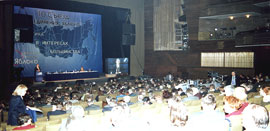
“People Are Tired. They Want Peace!” Yabloko Chairman Nikolai Rybakov addresses the Tver Region Legislative Assembly
Press Release, 19.02.2026

Photo by the Yabloko Press Service
Yabloko party Chair Nikolai Rybakov addressed the Legislative Assembly of the Tver Region, where he spoke about how throughout all four years of the military operations Yabloko had been advocating for the earliest possible ceasefire agreement and the preservation of human lives.
Read more »
Posted: February 20th, 2026 under Elections, Freedom of Speech, Governance, Human Rights, Regional and Local Elections, Regional and Local Elections 2026, State Duma Elections, State Duma Elections 2026, Yabloko's Regional Branches, Без рубрики.
Comments: none
On the destruction of the Gulag History Museum and the falsification of historical memory
Statement by Yabloko Chairman, 20.02.2026

Photo by the Yabloko Press Service
Today we have witnessed yet another step in the deliberate dismantling of national memory. The closure of the Gulag History Museum in Moscow and the attempt to “reformat” it [into a museum commemorating the victims of genocide of the Soviet people during WWII] constitute an act of distorting the very idea of preserving the truth about the tragic pages of our past.
Read more »
Posted: February 20th, 2026 under Governance, History, Human Rights, Overcoming Stalin's Legacy.
Comments: none
Yabloko nominates Ivan Bolshakov for the Central Electoral Commission
Press Release, 18.02.2026

Photo: Ivan Bolshakov at a meeting of the Yabloko’s Federal Council in 2025 / Photo: by the Yabloko Press Service
The Federal Bureau of the Yabloko party has put forward Ivan Bolshakov’s candidacy to the State Duma and the President for appointment to the new composition of the Central Electoral Commission (CEC). He has represented the party on the CEC since 2024.
Read more »
Posted: February 20th, 2026 under Elections, Political Parties.
Comments: none
Moscow Yabloko holds round table on the civil, political, and economic rights of Moscow residents
Press Release, 18.02.2026

Photo: Round table on the rights of Muscovites / Photo by the Yabloko Press Service
On 17 February, the Moscow branch of the Yabloko party held an extensive round table devoted to the rights of Muscovites. Experts in economics, urban heritage protection, and the electoral and judicial systems gathered at the party’s office to address the central question: are the rights of Moscow residents a genuine instrument of protection, or represent merely fiction?
Read more »
Posted: February 20th, 2026 under Elections, Environmental Policies, Freedom of Assembly, Freedom of Speech, Governance, Human Rights, Protection of Environment, Regional and Local Elections 2026, State Duma Elections, State Duma Elections 2026, Yabloko's Regional Branches, Без рубрики.
Comments: none
Yabloko submits application for a rally in Moscow in defence of Telegram, with up to 5,000 participants expected
Press Release, 18.02.2026

Photo: Kirill Goncharov, Ivan Bolshakov, and Nikolai Rybakov / Photo by the Yabloko Press Service
Yabloko party Chairman Nikolai Rybakov, member of the Federal Political Committee Ivan Bolshakov, and Chair of Moscow Yabloko Kirill Goncharov have submitted a notification to the Moscow city government regarding a rally in Moscow in defence of the Telegram messenger, access to information, and freedom of speech.
According to the notification, the event is scheduled for 1 March, with an expected attendance of up to 5,000 people.
Read more »
Posted: February 19th, 2026 under Freedom of Assembly, Freedom of Speech, Governance, Human Rights, Без рубрики.
Comments: none
Irkutsk Yabloko intends to hold a rally in defence of the Telegram messenger and “For a Free Internet!”
Press Release, 17.02.2026

The Chairman of the Irkutsk Regional Branch of the Yabloko party, Grigory Gribenko, together with political activist and human rights defender Pavel Kharitonenko, have submitted a notification to the Irkutsk city administration regarding a rally entitled “For a Free Internet!”. The applicants stressed that mass blocking of messengers and social networks was inadmissible and that citizens’ constitutional rights in the digital sphere must not be violated.
Read more »
Posted: February 19th, 2026 under Freedom of Assembly, Freedom of Speech, Governance, Human Rights, Yabloko's Regional Branches.
Comments: none
Screening of a documentary about legendary Russian journalist Yuri Shchekochikhin, “And the Ship Sails On”, to take place in Moscow
Press Release, 17.02.2026

The Yabloko party invites all to the launch of a documentary “And the Ship Sails On” about Yuri Shchekochikhin, the legendary Russian investigative journalist, politician, and member of the Yabloko faction in the State Duma (1995–2003). Yuri Shchekochikhin was murdered in 2003. The film will be launched at the party’s office in Moscow on 3 March.
Read more »
Posted: February 19th, 2026 under Conferences and Seminars, Freedom of Speech, Human Rights.
Comments: none
Mentorship project for Yabloko supporters and candidates to party members is launched in Moscow
Press Release, 17.02.2026

Photo: A mentorship project meeting in Moscow / Photo by Moscow Yabloko
On 15 and 16 February, Moscow Yabloko held the first meetings of participants in the mentorship project, which the Moscow branch of the party had announced at the beginning of February. Within the first days of the project, dozens of people joined Yabloko, wishing to realise their ideas, find support from like-minded individuals and mentors.
Read more »
Posted: February 19th, 2026 under Political Parties, Yabloko Youth, Yabloko's Regional Branches.
Comments: none
Yabloko announces the opening of applications for the Galina Mikhaleva Award “For Achievements in the Struggle for Gender Equality”
Press Release, 16.02.2026

Photo: Galina Mikhaleva / Photo by the Yabloko Press Service
The award has been established in memory of human rights defender, Doctor of Political Sciences, and Chair of the Yabloko party’s Gender Faction, Galina Mikhaleva. The 27th of February marks one year since her death.
Read more »
Posted: February 18th, 2026 under Conferences and Seminars, Gender Faction, Human Rights.
Comments: none
Evidence of 2025 electoral fraud goes missing from the Moscow Region Court: Yabloko publishes the copies of the missing video evidence
Press Release, 13.02.2026

Photo: A hearing at the Shchyolkovo City Court, which examined Yabloko’s claim against the Territorial Electoral Commission / Photo by the Moscow Region branch of Yabloko
The Moscow Region branch of Yabloko has published video recordings of four serious violations committed during the 2025 elections in the town of Fryazino, the Moscow Region. These materials — key evidence of electoral fraud on the part of the Territorial Electoral Commissions (TECs) — had been stored on a flash drive, featured in court proceedings, and then went suddenly missing between the first and second judicial instances.
Read more »
Posted: February 18th, 2026 under Elections, Governance, Judiciary, Regional and Local Elections, Regional and Local Elections 2025, Yabloko's Regional Branches.
Comments: none
Chair of Udmurtia Yabloko Iya Boronina demands disclosure of Ministry of Digital Development and Roskomnadzor acts that permitted the slowing down of Telegram
Press Release, 12.02.2026

Photo: Iya Boronina / Photo by the Press Service of the State Council of the Republic of Udmurtia
The leader of Yabloko in Udmurtia, Iya Boronina, sent an official request to the Ministry of Digital Development of Russia demanding to provide legal justification for the reasons for slowing down the Telegram messenger. The acts of the Ministry of Digital Development and Roskomnadzor (the Federal Supervision Agency for Information Technologies and Communications) that legally permitted the slowing down must be made public. In addition, Iya Boronina proposed introducing free Internet access points on the premises of kindergartens, schools, colleges and universities – to enable students to communicate with family members in the event of emergencies.
Read more »
Posted: February 12th, 2026 under Freedom of Speech, Governance, Human Rights, Yabloko's Regional Branches, Без рубрики.
Comments: none
Lev Shlosberg declared in court that materials in his criminal case had been falsified: the investigation changed the date of the “crime”
Press Release, 11.02.2026

Photo: Lev Shlosberg at the Pskov Regional Court hearing on 11 February 2026 / Photo by Pskov Yabloko
On 11 February, the Pskov Regional Court considered an appeal against the detention of Yabloko Deputy Chairman Lev Shlosberg. The appeal was rejected, and the judge ruled that Shlosberg must remain in remand prison until 2 April. The politician speaking in court declared that the date of the alleged “crime” had been falsified in the case materials – investigators may have changed it to create a chronology convenient for the prosecution so that the action (taking place in February 2022) would fall under provisions of a law on “fakes about the army” adopted later (in March 2022).
Read more »
Posted: February 12th, 2026 under Freedom of Speech, Governance, Human Rights, Judiciary, Yabloko's Regional Branches.
Comments: none
“We Are All Passengers on the Titanic”
The Nation, 07.02.2026

Photo: Grigory Yavlinsky / Photo by the Yabloko Party
On January 26, The Nation’s correspondent Nadezhda Azhgikhina interviewed Grigory Yavlinsky at his Moscow offices. Yavlinsky is the founder and leader of the Yabloko Party and a four-times candidate for the presidency of Russia (1996, 2000, 2012, 2018), in three of which he ran against Vladimir Putin, finishing third in March 2000 when Putin was elected for the first time. He was a member of the Russian State Duma in 1993–2003 and later a member of the St. Petersburg Legislative Assembly. A labor economist by training, Yavlinsky served as Vice Premier in the Russian Federation government in 1990 and Vice Premier in the last Soviet government in 1991. Azhgikhina is an independent journalist and writer and a frequent contributor to The Nation.
Read more »
Posted: February 12th, 2026 under Foreign policy, Governance, Human Rights, Russia-China Relations, Russia-Eu relations, Russia-Ukraine relations, Russia-US Relations, Без рубрики.
Comments: none
For a free Internet! Yabloko demands an end to restrictions on citizens’ lawful rights to use means of communications
Statement by the Yabloko Chairman, 11.02.2026

Photo by Sergei Konkov, Kommersant
Roskomnadzor [the Russian Federal Supervision Agency for Information Technologies and Communications] has begun major blockings of Telegram, citing its “failure to comply with Russian law” and that the alleged restrictions are allegedly needed to protect citizens from fraud and create conditions for preventing extremism and terrorism.
Read more »
Posted: February 11th, 2026 under Freedom of Speech, Governance, Human Rights, Без рубрики.
Comments: none
Academician Arbatov on the future of START: “We will have to conduct negotiations in a strategic vacuum. This will considerably complicate everything”
MK, 9.02.2026

Photo: Alexei Arbatov / Photo by the Yabloko Press Service
On 5 February, the New START Treaty expired – the last remaining agreement between Russia and the United States that had limited strategic offensive weapons. Shortly afterwards, US President Donald Trump expressed support for the idea of concluding a new, more modern agreement, noting the need to revise the terms and involve other nuclear powers.
Read more »
Posted: February 11th, 2026 under Foreign policy, Russia-China Relations, Russia-Eu relations, Russia-US Relations.
Comments: none
Pechora Court reduces Yabloko’s compensation for unlawful removal from 2023 municipal elections by 34 times
Press Release, 9.02.2026

Photo: Lawyers Vitaly Isakov and Maxim Kopytov representing Yabloko’s interests / Photo by Pskov Yabloko
The Pechora District Court has considered Pskov Yabloko’s claim for compensation for unlawful removal from the 2023 municipal elections. The proceedings lasted eight months, yet during this time none of the parties summoned to participate – from the regional electoral commission to the Russian Ministry of Finance – appeared in court. Ultimately, instead of the claimed 348,856 roubles, the court awarded Yabloko compensation of 10,000 roubles (approximately USD 100).
Read more »
Posted: February 10th, 2026 under Elections, Freedom of Speech, Human Rights, Judiciary, Regional and Local Elections, Regional and Local Elections 2023, Yabloko's Regional Branches.
Comments: none
Ruslan Zinatullin asks the Constitutional Court to reiterate its 2018 position and rule on the “rallies” law in its judgement
Press Release, 6.02.2026

Photo: Ruslan Zinatullin, 1 February 2025 / Photo by the Tatarstan branch of Yabloko
Ruslan Zinatullin, leader of Yabloko in Tatarstan, is asking the Constitutional Court of the Russian Federation to issue a separate Judgement that would make it impossible to hold participants in street actions liable for using placards that the police deem inconsistent with the declared theme of the action.
Read more »
Posted: February 9th, 2026 under Freedom of Assembly, Freedom of Speech, Human Rights, Judiciary, Yabloko's Regional Branches.
Comments: none
Moscow Yabloko to host round table on muscovites’ civil, political, economic and social rights
Press Release, 6.02.2026

The Moscow branch of Yabloko invites participants to a Round Table with experts in economics, urban heritage protection, electoral and judicial systems – “The Absence of Muscovites’ Rights in Moscow: The Fiction of Participation and the Reality of Prohibitions”.
Read more »
Posted: February 9th, 2026 under Conferences and Seminars, Yabloko's Regional Branches.
Comments: none
Deputy Chair of Novgorod Yabloko Yelena Ivanova fined for “displaying extremist symbols”, and thus, barred from running in 2026 elections
Press Release, 6.02.2026

Photo: Yelena Ivanova / Photo by Novgorod Yabloko
On the evening of 5 February, Novgorod District Court delivered a guilty verdict against Deputy Chair of the Novgorod branch of the Yabloko party, Yelena Ivanova. The court found her guilty of “displaying extremist symbols” (Article 20.3 of the Code of Administrative Offences) and fined her 2,000 roubles. Following this decision, Yelena Ivanova will be barred from standing in elections for one year, including the 2026 campaigns for the State Duma and the Novgorod Regional Duma.
Read more »
Posted: February 9th, 2026 under Elections, Freedom of Speech, Human Rights, Judiciary, Regional and Local Elections, Regional and Local Elections 2026, Yabloko's Regional Branches.
Comments: none
“It is unclear how saving videos undermined the authority of the government”: consideration of the appeal against Lev Shlosberg’s sentence continues
Press Release, 6.02.2026

Photo: Lev Shlosberg at the hearing on 5 February 2026 / Photo by Pskov Yabloko
On 5 February, the Pskov City Court held a second hearing to consider Lev Shlosberg’s appeal against the sentence in the criminal case concerning “missing ‘foreign agent labels’”, as Shlosberg saved several videos (posted by other people) on his VKontakte social media page without supplying them with mandatory foreign agent labels (which is, in fact, impossible to do on the network from even from a technical point view for posts whose authors are other people). The politician was participating in the proceedings in person.
Read more »
Posted: February 6th, 2026 under Freedom of Speech, Governance, Human Rights, Judiciary, Yabloko's Regional Branches, Без рубрики.
Comments: none