Is
Modernisation in Russia Possible? Interview
with Grigory Yavlinsky and Boris Titov by Yury Pronko,
"The Real Time" programme, Radio Finam, May
12, 2010
Every fifth family in Russia does not have access to a centralised sewage system. But neither the government nor the regional authorities are going to do anything about it. Why? Simply because if they allocate money for sewage, they really have to build it, because sewage has specific consumers – millions of people all over Russia, and they will definitely ask about it. But they are always eager to give Rosneft 400 billion roubles for development of Arctic oil deposits (although the volume of oil reserves in the permafrost has not even been confirmed) or Rostech [the Russian technological corporation for facilitation of development of highly technological products] “the amount that is not to be disclosed”, or [funding] creation of a Russian equivalent of Skype. Because the real costs of these state-owned corporations cannot be checked and, probably, only Igor Sechin [head of Rosneft] and Sergei Chemezov [head of Rostech] know the real cost of their developments.
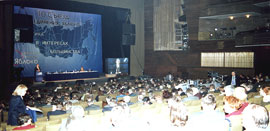
Chairperson of the Yabloko party, Emilia Slabunova, spoke today at the 6th Congress of the Russian Association of Political Consultants. The politician took part in the discussion on the topic “A New Period for Political Parties”.
On 30 March, the Kalmyk regional branch of the Yabloko party held a rally dedicated to the Constitution (the Steppe Code) of the Republic of Kalmykia. The rally discussed not only the problems of the Constitution of the Republic of Kalmykia, but also a wide range of issues related to the basic law of Kalmykia: what rights and powers are provided by the Constitution and how they are implemented in practice.
Grigory Yavlinsky on the results of the investigation of Russia’s interference into the US elections
Grigory Yavlinsky’s web-site, 26.03.2019
The investigation by Robert Muller, Special Counsel [of the investigation into Russian interference in the 2016 United States elections] ended without charge or justification. Robert Muller did not find evidence of Donald Trump’s collusion with Vladimir Putin in the 2016 presidential election. Obviously, Muller was looking for some documents, testimony, contacts, evidence of direct agreements with Trump or his assistants about the interaction, playing the pass, carrying out some election campaign “special operations”… And he did not find anything like that.
The police withdrew samples of campaign materials from the office of the Moscow branch of the Yabloko party (Pyatnitskaya 28, Moscow) and intends to check them for extremism.
Today, we have two news related to the prosecution of our party. I will start with the good one:
The criminal case against Lev Shlosberg [MP of the Pskov Region parliament and head of the Yabloko branch in Pskov] and the Pskov Yabloko was closed due to the absence of corpus delicti.
Today, police officers from the criminal investigation department came to the office of the Moscow Yabloko after receiving an anonymous call on alleged presence of extremist literature [in the Moscow Yabloko office]. The police took samples of campaign materials, now they will be checked for extremism. I would like to say to the law enforcement bodies: do your profile work in catching criminals (alas, there is a lot of it in Russia) instead of distracting members of a registered party from their work.
This year, the head of Ingushetia proposed to make such amendments to the constitutional law on referendum so that the republic’s leadership could solve the issues of the region’s borders without the consent of its residents.
Nikolai Rybakov, Deputy Chairman of Yabloko, spoke at the rally in Magas
Press Release, 26.03.2019
A rally against amendments to the constitutional law on referendum is held in the city of Magas, the capital of the Republic of Igushetia, today. If the amendments are adopted, this will allow the leadership of the republic to resolve issues of the region’s borders without consent of the residents of Ingushetia.
About 20,000 participants, which makes up a seventh part of the total adult population of the Republic, have gathered today in the central city square. According to Nikolai Rybakov, Deputy Chairman of Yabloko, who arrived in Magas to support the peaceful civil protest, a small town with a population of less than 9,000 people was completely filled by cars, as people from all over the Republic came to participate in the rally.
The ceremony of the “Golden Pen – 2018” award for journalists took place in St. Petersburg.
Lina Zernova, member of Yabloko St. Petersburg and Co-Chair of the Guild of Environmental Journalists of the Union of Journalists of St. Petersburg and the Leningrad Region, won the special prize of the for High Quality Journalistic Work.
A mass rally “Free Elections for St. Petersburg!” was held in St. Petersburg on 24 March. The rally was timed to the 30th anniversary of the first free elections to the Supreme Soviet [parliament] of the USSR. Yabloko’s Boris Vishnevsky was a co-anchor of the rally.
About 800 people – members and supporters of political parties, representatives of public organisations and citizens – came this day to Lenin Square to remember that once elections were really free.
In the twentieth year of Putin’s rule, an understanding of freedom in Russia was reduced to the discussion of punishment for posts and likes on the Internet. But what is real freedom? This is primarily life without fear:
– when people are not afraid of the police, the National Guard (Rosgvardia) and the Federal Security Service (FSB);
– when people are not afraid that their business will be taken away from them;
– when people are not afraid to build housing for themselves like equity holders, when they are not afraid to get under some kind of “renovation”, when they are not afraid that their family will be thrown out of the apartment due to someone else’s absurd decision;
– when people are not afraid that they do not have enough money to educate their children;
– when people are not afraid that their elderly parents will be left without pensions and medicines.
Tomorrow, 26 March, a rally will be held in the city of Magas, the capital of the Republic of Ingushetia, on the issue of preserving the territorial integrity of the Republic. Nikolai Rybakov, Deputy Chairman of Yabloko, will speak at the rally.
Residents of Ingushetia are outraged by the desire of the National Assembly – the legislative body of the Republic – to adopt a new wording of the constitutional law on referendum, which will allow to solve the problems of the region’s borders without the consent of its residents.
On 22 March, Galina Mikhaleva, Chair of the Gender Faction of the Yabloko Party, gave a lecture for St.Peterburg activists in the Yabloko office in St. Petersburg. The lecture was devoted to the struggle for gender equality, the history of the Yabloko Gender faction, Yabloko programme provisions for ensuring gender equility, interaction with civil society activists and NGOs and the present tasks of the faction and the party.
Emilia Slabunova, Chair of the Yabloko party and MP of the Legislative Assembly of Karelia, spoke against the bill on reducing the requirements for investors in Karelia at the Karelian parliament today.
Alexander Safronov, member of the Yabloko party from the city of Yeisk in the Krasnodar region, was found guilty of committing an administrative offense under Article 20.33 of the Administrative Code of the Russian Federation “Conducting activities of an undesirable organistion on the territory of the Russian Federation” because of his repost on Facebook of a video by the Open Russia organisation about the lack of schools in Krasnodar.
The first hearings on the lawsuit of the Chelyabinsk branch of Yabloko to the City Duma were held in the Chelyabinsk Regional Court. The regional branch of the party asks the court to invalidate the decisions of the City Duma approving the regulations on the procedure for holding a competition to select candidates for the position of head of the city of Chelyabinsk, as well as to announcing a competition and electing the head of the city of Chelyabinsk, because they violate the rights of the competition participants and city residents.
Five years ago, Vladimir Putin, with mass support of Russians annexed Crimea. Today, they talk a lot about the “price of Crimea”, give figures, the size of subsidies, allocations, expenses for the construction of a bridge, etc. However, this is not so much about Crimea as about the stagnant Russian economy and inefficiency of governing. By the way, few people believe that with these considerable expenses, people in Crimea began to live much better, freer, safer than before, until 2014, and corruption actually fell for the five years. True, many people there have preserved their Ukrainian passports. In fact, Russia’s payment for Crimea is huge. The price we pay for Crimea is not to be counted in dubious official figures, percentage of the budget share or GDP. The price is different:
A year has passed since the presidential election. Many then were saying that the voting itself did not matter, that the result was predetermined, that there were more important things… As a result, a year ago Vladimir Putin received a mandate to change nothing in the country, to keep everything as it was before: sanctions, isolation, confrontation with the whole world, support of the war in Ukraine, participation in the war in Syria, corruption in all power structures, suppression of civil liberties and propagandistic lies in the media. Putin did not disappoint the expectations: isolation and wars remained, but the so-called “pension reform”, increased taxes, an arms race, and laws on punishment for insulting the authorities and isolating the Internet added to this.
Statement of the St.Petersburg branch of Yabloko, 20.03.2019
Photo: Maria Karpenko and Boris Vishnevsky, Yabloko MP in the St.Petersburg Legislative Assembly
On Tuesday, 19 March, Maria Karpenko was sacked from her post of correspondent for the Kommersant newspaper. The reason for this outrageous dismissal was [her criticism of Alexander Beglov, acting Governor of St.Petersburg in] the Rotonda channel co-authored by Maria in the Telegram network. According to Vladimir Zhelonkin, head of the [Kommersant] publishing house, the texts published by Maria in the Rotunda did not meet the approved requirements of the Kommersant paper. He stated that the Rotunda channel represented “activism incompatible with journalistic status.”
Alexander Goncharenko, leader of the Altai branch of Yabloko, sent appeals to Ivan Gilev, Minister of Construction and Housing and Communal Services of the Altai Territory, as well as to Vladimir Popryadukhin, regional Minister of Natural Resources and Ecology, asking them to answer a number of questions about the “garbage reform” that worried residents of the region.