Is
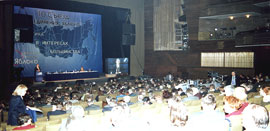
Modernisation in Russia Possible? Interview
with Grigory Yavlinsky and Boris Titov by Yury Pronko,
"The Real Time" programme, Radio Finam, May
12, 2010
Photo: Signing of the agreement between the “Donetsk People’s Republic”, the “Luhansk People’s Republic” and Russia in the Kremlin on 21 February, 2022. / Photo from kremlin.ru
President Vladimir Putin announced Russia’s recognition of the “independence” of the self-proclaimed “republics” – the “Donetsk People’s Republic” and the “Luhansk People’s Republic”, signed agreements on “mutual assistance” with them, and sent Russian troops to their territories.
Russian regions have begun introduction of a state of emergency regime in anticipation of an inflow of refugees from Donbass. Up to a million people are expected to be evacuated from the “Donetsk People’s Republic” and the “Luhansk People’s Republic”. Svetlana Gannushkina, Chairperson of the Civic Assistance Committee and a member of the Political Committee of the Yabloko party, notes that Russia does not have a positive experience in accepting refugees, especially in such large numbers.
In actual fact, the war started eight years and has never stopped, leaving over 13,000 dead, and countless refugees. Hundreds of thousands of Donbass residents are actually hostages in Moscow’s geopolitical games. Meanwhile the entire campaign of intimidation and scaremongering about war and appeals for recognition of the independence of the Donetsk People’s Republic and the Luhansk People’s Republic attest to the actual indifference of the Russian regime to the lives and fate of Donbass residents. The goal is not to protect the people, but instead to bring Ukraine to heel, subjugating it to Russian-controlled Donbass in all key areas. There are good reasons for assuming that this won’t happen.
In autumn 2017 we published a plan “Settlement in Donbass: Ten Points”. This plan could have provided the framework for a discussion on how to restore peace to the east of Ukraine. Today, this plan (with minor adjustments and additions) is still a solution that would guarantee the real and long-term security of the region’s residents and stop the war. This plan was one of the key policy documents of my campaign in Russia’s presidential elections in 2018. The Kremlin is acquainted with this plan. Instead of unleashing war, this plan must be implemented. Admittedly, taking such a step would require political will.
Photo: the Rostov-on-Don region, February 2022. Photo by Igor Ivanko / Kommersant
As of Monday noon MSK, 15,025 people left their signatures under the anti-war petition launched by Yabloko on its website. The number of signatures rose by more than 30 per cent after the aggravation of the situation in the so-called “People’s Republics” of Donetsk and Luhansk on the evening of 18 February.
On the eve of the 518th meeting of the upper chamber of the Russian parliament – the Federation Council, – which will be held on February 22, Yabloko Chairman Nikolai Rybakov sent appeals to all members of the Federation Council with a proposal to cancel the Resolutions allowing the use of Russian armed forces abroad. According to Rybakov, this will be a practical step aimed at the reduction of tensions around Ukraine.
Attention: the number of regions in the title changes as we open new points of collection of signatures.
Photo: A sign at the collection point in Moscow / Photo by the Yabloko Press Service
Regional branches of the Yabloko party launched a collection of signatures against the war with Ukraine in their offices. At present Yabloko collects signatures against the war with Ukraine in 36 regional collection points in 35 Russian regions.
Citizens can express their strong protest against the war, that would be disastrous for the two nations, in the following cities: Arkhangelsk, Barnaul, Blagoveshchensk, Novgorod, Vladivostok, Voronezh, Ivanovo, Izhevsk, Kemerovo, Kirov, Kurgan, Lipetsk, Makhachkala, Moscow, Murmansk, Novosibirsk, Oryol, Orenburg, Perm, Pskov, Rostov-on-Don, Ryazan, St. Petersburg, Saratov, Smolensk, Stavropol, Taganrog, Tambov, Tomsk, Tula, Tyumen, Ulyanivsk, Chelyabinsk, Chita, Shakhty, and Yakutsk.
On 16 February, Viktor Leonidovich Sheinis, a member of the Federal Political Committee of the Yabloko party, turns 91. Party Chairman Nikolai Rybakov congratulates Viktor Sheinis on his birthday:
Chair of the Yabloko Party Gender Faction Galina Mikhaleva also signed the letter
Photo by Maxim Bogodid / RIA Novosti
We are women from the United States and Russia who are deeply concerned about the risk of imminent war between our two countries, who together possess over 90% of the world’s nuclear weapons.
We are mothers, daughters, grandmothers, and we are sisters, one to another.
Today we stand with our sisters in Ukraine, East and West, whose families and country have been torn apart, have already suffered more than 14,000 deaths.
We stand together and we call for peace and diplomacy, with respect for all.
Over 5,000 people put their signatures underthe petition of the Yabloko party against the war between Russia and Ukraine on the first day of the collection of signatures.
The Yabloko party launches collection of signatures against the war with Ukraine. We will collect signatures not only on the Internet, but also in our offices across the country. Wherever we can, and where covid sanitary restrictions allow, we will conduct picketing. The list of collection points will be published soon. Please share the link to this page on your social networks, send it via instant messengers to your friends, neighbours and colleagues – it is very important that there are many people speaking out against the war.
Photo: Tank T-72B3 of the armed forces of the Union State of Russia and Belarus during military exercises at the Brest training ground. Photo by Viktor Tolochko / RIA Novosti
The Yabloko party launches collection of signatures against the war with Ukraine. Signatures under a petition to the Russian government will be collected not only on the Internet, but also in the offices of Yabloko across the country. Yabloko activists will go on pickets in the regions where covid sanitary restrictions allow. The list of collection points will be published soon.
Photo: Alexander Korovainy /Photo from Alexander Korovayny’s social networks
Alexander Korovainy, a member of Yabloko and ex deputy of the Yeisk District Council, was appointed assistant to Alexander Baturints, a current deputy of the Yeisk District Council and a supporter of the party.
Photo: Alexander Biryukov, Alexander Korovainy, and Sofia Pilyukova / Photo from social networks
Alexander Korovayny, a former deputy of the Yeisk District Council from the Yabloko party, Alexander Biryukov, a Yabloko member and Deputy Chairman of the North Caucasus Environmental Watch, and Sofia Pilyukova, a public activist and a Yabloko volunteer in the parliamentary elections in 2021, were included into the ranking of public figures of the Krasnodar Territory based on the results of work in 2021. The ranking was published by the human rights Internet portal Protocol basing on the results of an expert assessment by well-known journalists, members of the regional Public Chamber, the Governor’s Council for the Development of Civil Society and Human Rights, municipal deputies, and members of public organisations.
Photo: Oleg Mandrykin and Yabloko Chairman Nikolai Rybakov (left). / Photo by the Yabloko Press Service
All the offices of the real estate agency Variant in Severodvinsk, the Arkhangelsk region, headed by Oleg Mandrykin, one of the leaders of the STOP-SHIES coalition [a public movement against organisation of a giant landfill instead of part of the forest in the Arkhalgensk region where waste from Moscow and some of Western Russian regions could be transported and stored], were simultaneously searched. According to the official version, the searches were caused by an inspection under Article 198 of the Criminal Code of the Russian Federation on non-payment of taxes. The Arkhangelsk regional branch of Yabloko is confident that the attack of the authorities on the business of the opposition activist represents political pressure.
Among the candidates are head of the Russian Guard, Minister of Culture, head of the Central Electoral Commission and the governors of Chelyabinsk and Novgorod Regions.
Press Release, 8.02.2022
Photo by the Yabloko Press Service
The Yabloko Anti-Corruption Policy Centre has opened voting (https://www.yabloko.ru/lp/brush/ ) for this year’s “Zolotoy Yorshik” (Golden Toilet Brush) Anti-Award. The prizes (golden, silver and bronze colour toilet brushes) are awarded in recognition of the most wasteful budgetary expenditures by government officials. The more absurd the expense, the more likely it is to receive the Toilet Brush.
Boris Vishnevsky, Deputy Chairman of Yabloko and an MP of the Legislative Assembly of St. Petersburg, sent an appeal to Natalia Putilovskaya, Chair of the St.Petersburg Committee on Education, with a request to conduct a check into the actions of Svetlana Lebedeva, Principal of School No. 168, who, according to teacher Serafima Saprykina, forced her to quit school in December 2021 for her reсiting to the students verses by Daniil Kharms and Alexander Vvedensky, the poets arrested and repressed in the Stalin’s period and labelled “enemies of the people” and tragically died in 1941.
Sergei Mitrokhin, Yabloko deputy of the Moscow City Duma, investigated the takeover of the Kolomna Dairy Plant from by Alexei Tkachyov, a State Duma deputy from the ruling United Russia party. Police helped Tkachyov in taking away the plant from its owner. “Reacting to the appeals of my Moscow voters (during the State Duma elections), I conducted my own investigation. It turned out to be a deputy investigation of a deputy’s takeover of a plant, ” Mitrokhin says.
Press Release, 4.02.2022Photo: Boris Vishnevsky / Photo from the website of the Legislative Assembly of St. Petersburg
Boris Vishnevsky, a member of the Legislative Assembly of St. Petersburg and deputy chairman of Yabloko, sent an appeal to Igor Krasnov, Public Prosecutor General of Russia, with a request to launch prosecutor’s investigation into for signs of crime in the statements of the head of the Chechen Republic Ramzan Kadyrov, who publicly called “terrorists” and “accomplices of terrorists” Igor Kalyapin, a member of the Council for Human Rights and Development of Civil Society under the President of the Russian Federation, Yelena Milashina, journalist of Novaya Gazeta, and two media – the Novaya Gazeta newspaper and the Dozhd TV channel. At the same time, Kadyrov said that “we have always eliminated terrorists and their accomplices, and there is no difference between them, and we will go on with this further.”